
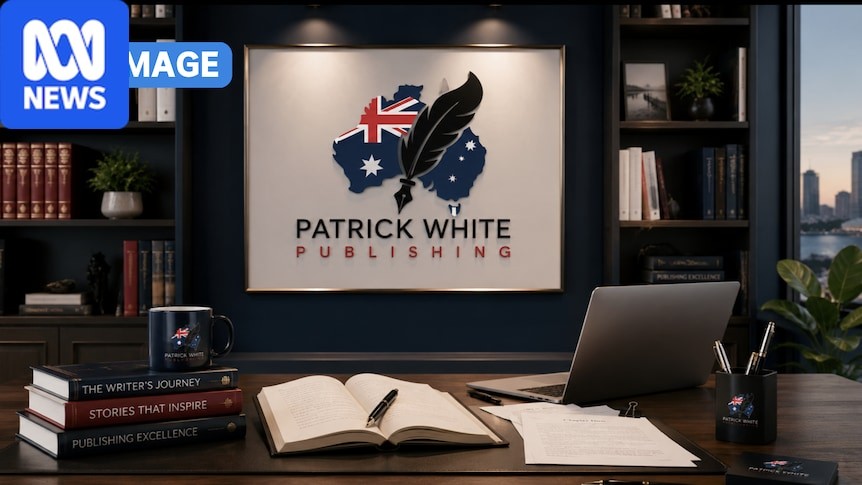
Australian authors who paid hundreds of dollars to a self-publishing company operating under the name Patrick White Publishing say they received poor editing, pressure to pay more, and illustrations generated by artificial intelligence, according to an Australian Broadcasting Corporation investigation published on October 24.
The ABC report also found the company, which trades as PW Publishing House, uses an Australian Business Number belonging to an unrelated firm and displays AI-generated storefront images for addresses in Hobart and Melbourne that appear to have no connection to its operations.
Authors describe poor editing and refused refunds
Kerry Stewart, a dark fantasy author from Mudgee in New South Wales, signed with the company after a representative persuaded her to proceed despite negative reviews she had found online. She paid $500 for editing services.
''All they'd done was like grammar and things like that, they hadn't done anything else to enhance the book,'' Ms Stewart told the ABC.
She said staff inserted mistakes into her manuscript and, when she corrected and returned it, edited an old version instead. The company promised a professional editing team would fix the problems, but she said the same issues kept recurring.
Ms Stewart sought a refund under the ''100% satisfaction & money-back guarantee'' advertised on the company's website. She said the company told her it does not give refunds to people who ''simply changed their mind''. She said a representative later offered to refund her if she removed a Facebook post warning other writers, but refused to pay first.
''So it's not even my money, I wasted other people's money,'' she said, explaining she had crowdfunded the payment.
Melbourne author quoted $400, then offered a $1,899 bundle
Tulin Salis, a Melbourne-based children's book author, was told in writing that a $400 payment would cover her full publishing process across 10 major platforms, with no further fees. After she paid and submitted her manuscript, the company emailed details of a ''5-Star Ghostwriting Bundle'' priced at $1,899, including $900 for custom illustrations.
The company also proposed expanding her 27-page children's book to between 100 and 150 pages, which Ms Salis rejected as contrary to the book's purpose. In an email seen by the ABC, a representative wrote that he would not argue ''over every dollar or every sentence of an email'' and referred to the company's legal department.
Ms Salis said she has not received a refund.
AI-generated covers and storefront images
An OpenAI watermark detection tool showed that storefront images on the company's Google Maps listings for 118 Liverpool Street, Hobart, and a Melbourne address were AI-generated. The real Hobart building houses a food company's head office and an accountancy firm, none of which appear related to the publisher.
Book covers promoted on the company's website also returned positive results for watermarks from OpenAI and Google Gemini, yet contracts reviewed by the ABC make no mention of AI use. Brisbane author Sheena Avison said a representative rejected her own AI-generated images, claiming Amazon would not accept them, even though Amazon's Kindle Direct Publishing only requires authors to declare AI content.
Ms Avison recovered her $400 through a PayPal dispute. The company responded to her Trustpilot review saying it took concerns seriously and disagreed with several claims.
ABN taken from another business
Corporate searches show the ABN on the company's website and invoices belongs to an unrelated firm sharing the initials P and W. An office holder of that company told the ABC he had never heard of Patrick White Publishing and had reported it to the Australian Taxation Office and Scamwatch. Using someone else's ABN is illegal and can carry a two-year prison term.
Patrick White estate demands the company stop using the name
The publisher shares its name with Patrick White, the only Australian winner of the Nobel Prize in Literature, who died in 1990. The company's website does not claim any connection to the late author, but Jane Novak, literary executor of the Patrick White estate, said she had written several times asking the firm to stop using the name and received no reply.
''It just feels like a particularly cruel thing to do at this particular moment in time,'' Ms Novak said, noting that aspiring writers are especially vulnerable in a difficult publishing market.
Patrick White Publishing did not respond to the ABC's requests for comment. One author, Pauline Gill of Woodstock in New South Wales, said she was satisfied with the $17,000 she paid the company for editing, marketing and publication across print, ebook and audiobook formats, even after learning her cover illustration was AI-generated from photos she supplied.
The allegations fit a wider pattern of publishing fraud. According to The Dial, United States authorities found more than 800 authors were defrauded of upwards of $48 million in one publishing scheme. Separately, Books & Review reported that around 300 authors sued Meta in a San Francisco federal court on October 19, seeking up to $150,000 per work in statutory damages over AI training, while debates over AI art in publishing continue to divide authors.
Frequently asked questions
Is Patrick White Publishing connected to the author Patrick White?
No. The literary estate of Patrick White, Australia's only Nobel Prize in Literature winner, has asked the company to stop using the name and says it has received no response.
What should authors do if a publishing service refuses a refund?
Authors can lodge disputes through payment platforms such as PayPal, report the company to Scamwatch, and, where a false ABN is used, to the Australian Taxation Office.
Is using AI for book illustrations illegal in Australia?
No, but Amazon's Kindle Direct Publishing requires authors to declare AI-generated content, and failing to disclose AI use in a publishing contract may support a refund claim.