
Almost 146,000 hectares of state forests and timber reserves in Western Australia have been identified as potentially suitable for ecological thinning, a practice that is drawing criticism from local residents and independent scientists who argue it amounts to native logging under another name.
The technique, which involves removing smaller trees to allow remaining ones to flourish, is being trialled across the state's South West region. The stated goal is to restore old-growth forest conditions. But with logging trucks still active in the area, questions are mounting over whether the program is genuinely different from the commercial logging that was banned in 2024.
What is ecological thinning and why is it being used?
Ecological thinning is based on the premise that trees in the South West are competing for water in a drying climate, causing stress and collapse in regrowth forests of karri, jarrah and marri. These forests, recognised as globally significant biodiversity hotspots, were clear-felled for nearly 200 years before native logging was phased out entirely in 2024.
Katinka Ruthrof, a scientist with the Department of Biodiversity, Conservation and Attractions (DBCA), told the ABC that the region is moving into a warmer, drier period that has put stress on forest ecosystems. During a visit to a thinned site, she pointed to retained trees marked with white spray-paint, while stumps had been treated with glyphosate to prevent regrowth.
“We've compared that with the unthinned area, and the trees in the thinned area are less stressed,” Dr Ruthrof said.
Critics say the practice is 'logging by another name'
Since native logging was banned in 2021 and fully phased out in 2024, roughly 3,000 hectares of state forest have been ecologically thinned. That represents 0.2 per cent of WA's forest and timber reserves. But for some locals, the activity looks familiar.
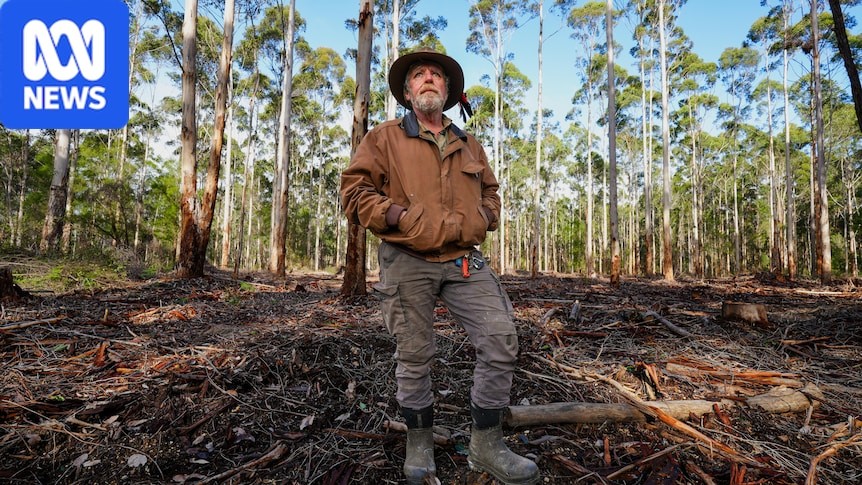
Jeff Thornton, a retired teacher and volunteer firefighter near Pemberton, 320 kilometres south of Perth, has watched contractors thin forest around his property for 18 months. “I say it's native logging by euphemism,” he said.
Mr Thornton showed the ABC a recently thinned site where larger stumps remained while smaller trees appeared to have been left standing. “There's no big trees,” he said. “Where are all the big trees?”
He also raised concerns about wildlife, noting that black cockatoos that had nested on his property every year failed to return this season.
The DBCA said it conducts independent inspections and assessments of the sites, which are managed by WA's Forest Products Commission (FPC).
What evidence supports ecological thinning?
Ecological thinning is a relatively new approach, and scientists are drawing on historical data from thinned sites during the native logging era to guide current practice. Dr Ruthrof said the department is using that information to assess how catchments responded to drought and heatwaves in 2011 and 2024.
Early indications suggest thinned sites are experiencing less water stress. “That information is coming in already, which suggests we're going in the right direction,” she said.
The DBCA argues the process differs from native logging because only smaller trees are removed. However, there is no consistent maximum tree diameter across the program, with FPC supply contracts varying from site to site. Contractors, many of whom are former native logging companies, are trained by departmental silviculturists to identify which trees to thin.
Independent experts question the scientific basis
Professor David Lindenmayer, a conservation biology expert at the Australian National University, said there is limited scientific evidence to support ecological thinning. He noted that Australian forests have existed for about 180 million years and have survived without such interventions.
“The reality is that forests have been in Australia for about 180 million years and that means that people haven't been messing with them for 179,930 years, and they've survived very well ... without those kinds of interventions,” he said.
Professor Lindenmayer said thinning should only be considered when invasive species are taking over, and he would not recommend it for karri and jarrah forests. He also warned that thinning can increase temperatures on the forest floor, leave debris that acts as fuel, and create windier, drier conditions that make fires worse.
He disputed the claim that thinning can correct the legacy of logging and dense regrowth. “Forests will naturally self-thin as they grow older — that is a dynamic that we see in every kind of forest all over the world.”
Government defends the program
Agriculture Minister Jackie Jarvis, who oversees the FPC, declined an interview request from the ABC. In a statement, Environment Minister Matthew Swinbourn said ecological thinning would help make the South West's forests more resilient.
“Research has shown that thinning forests can improve groundwater recharge and streamflow,” Mr Swinbourn said. “It can also reduce the vulnerability of forests to drought and heatwaves over the medium to long term.”
The minister said the practice will be reviewed over the next two years to determine its effectiveness.
Will ecological thinning continue in WA?
The program is set to continue while the review is conducted. Scientists and the department maintain that thinning is a necessary adaptation to a changing climate, while critics argue it is a return to logging by another name. The outcome of the two-year review will determine whether the practice becomes a permanent feature of forest management in Western Australia.