
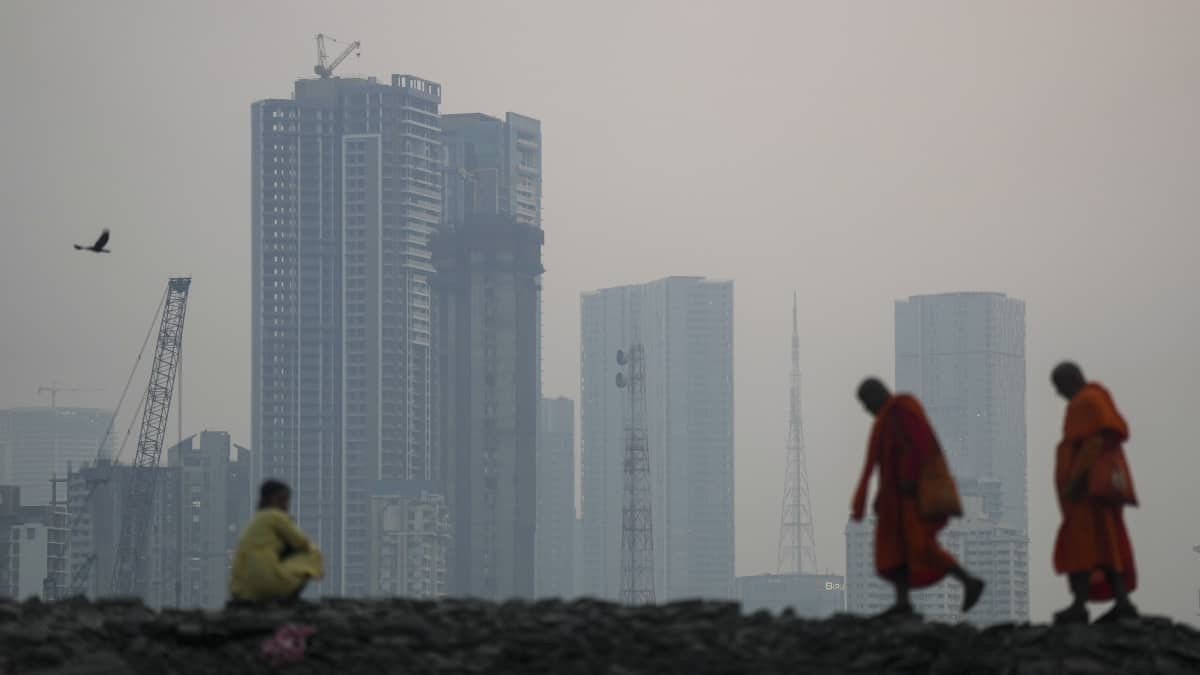
Mumbai briefly overtook Delhi in IQAir's live global pollution rankings this month, with the coastal city recording an air quality index of 165 on October 21, according to Firstpost's reporting on the episode. That placed Mumbai fourth among the world's most polluted cities on the Swiss platform's real-time list, a rare inversion of the usual order in which the capital's air is judged the more hazardous.
The shift has renewed scrutiny of how weather and local emissions interact along India's western seaboard, and of what the comparison between the two cities actually measures. The reading came during a month of haze, weak winds and temperatures above 35°C across Mumbai.
Why Mumbai's sea breeze failed to clear the air
Mumbai's position on the Arabian Sea normally works in its favour. Daytime land temperatures rise faster than the sea's, drawing cooler marine air inland and helping to disperse pollutants. That advantage appeared to weaken through October.
Independent meteorologist Athreya Shetty told Firstpost that the early withdrawal of the monsoon on October 3 left the region governed by a seasonal anticyclone over Gujarat and north Maharashtra. The system brought persistent, light easterly winds from the interior, delaying the sea breeze until late at night, by which time it was too weak to clear the air before the easterlies returned.
High-pressure regimes can also produce temperature inversions in the lower atmosphere, where temperatures rise rather than fall with altitude. Shetty described these inversions as a lid that suppresses vertical mixing and traps dust and construction particles near the ground. Easterly winds can carry smoke from farm fires in the interior as well.
Research supports the pattern. A 2024 study in Science of the Total Environment analysing nearly seven years of PM2.5 data from five Indian coastal cities, Mumbai among them, found that weaker sea-land breeze circulation was associated with higher concentrations of fine particles.
How October's readings compare with Delhi
Mumbai's AQI of 165 on October 21 marginally exceeded Delhi's 164 on the same platform, according to NDTV's account of the rankings. It was the second time in 2026 that Mumbai had drawn level with or passed the capital, India Today reported, after a reading of 152 on October 15 during unusually hot and humid weather that followed a rain-deficient monsoon.
The comparison carries caveats. IQAir draws on a mix of public and private monitoring data, and government agencies have described air quality in both cities as moderate even as private platforms showed alarming figures, Tmv noted. Single-station readings and differences in monitoring coverage can distort city-to-city comparisons.
Within Mumbai, pollution varied sharply by neighbourhood. An analysis by Good Air of Central Pollution Control Board data between October 10 and 23 found Deonar recorded the highest average AQI among qualifying monitors at 139, followed by Khindipada in Bhandup West at 133 and Navy Nagar-Colaba at 130. Borivali East's Maharashtra Pollution Control Board monitor averaged 69. Coarse particles from road and construction dust dominated the city's index during the period.
Kinjal Shah, an independent urban planning expert, told Firstpost that traffic, construction, road dust and weather all influence local levels, with waste burning a further potential source that monitoring data alone cannot confirm.
What the emissions data shows
A 2024 emissions inventory estimated Mumbai's annual output at 44 gigagrams of PM2.5 and 72.5 gigagrams of PM10, based on 2020 activity data. Transport accounted for 19.6 per cent of estimated PM10 emissions, windblown road dust 19.4 per cent and industry 18.9 per cent. The study flagged waste burning as an emerging source. These are estimates of what is released, not measurements of what residents breathe at any one location.
Akshay Deoras, a senior research scientist at the National Centre for Atmospheric Science and the Department of Meteorology at the University of Reading, cautioned against reading too much into a single month. Lower rainfall can reduce the removal of pollutants from the atmosphere, he told Firstpost, and levels can rise even under broadly similar weather if emissions increase or the air becomes more stagnant.
Deoras said establishing whether Mumbai's coastal advantage is weakening would require detailed analysis of long-term trends in wind speeds and sea-breeze patterns, to separate sustained change from ordinary variability. High-resolution atmospheric simulations combined with observational data and emissions inventories, he added, would be needed to quantify how much of this October's pollution came from weather and how much from emissions.
Why the comparison matters beyond Mumbai
For Australian readers, the episode is a reminder that air quality rankings are only as good as the networks behind them. Coastal geography offers no guarantee against severe pollution when the right weather pattern settles in, and cities that have long relied on sea breezes to cleanse their air may find that assumption tested as emissions grow.
The immediate question for Mumbai is seasonal. Winter typically brings the year's worst air, with PM2.5 concentrations far above monsoon levels in the SAFAR observations analysed for 2016 to 2021. Whether October's inversion proves a preview or an anomaly will depend on the winds of the coming weeks, and on whether the city's transport, construction and waste sectors bend their emissions downward.
Frequently asked questions
Did Mumbai really have worse air than Delhi in October 2026?
On IQAir's live ranking, Mumbai reached an AQI of 165 on October 21 against Delhi's 164, a marginal difference. Government monitoring described air quality in both cities as moderate, and the two cities use different monitoring networks.
Why did Mumbai's sea breeze not disperse pollution?
An anticyclone over Gujarat and north Maharashtra brought light easterly winds and delayed the sea breeze until late at night, when it was too weak to clear pollutants before the easterlies returned the next day.
Which parts of Mumbai recorded the worst air?
Between October 10 and 23, Deonar averaged an AQI of 139, Khindipada 133 and Navy Nagar-Colaba 130, while Borivali East's MPCB monitor averaged 69.