
At least 68 people were killed and dozens more injured on Wednesday when two high-speed trains collided in central Spain, the deadliest rail disaster in Europe in more than a decade.
The crash occurred between the villages of Urda and Los Yébenes in Toledo province, about 130 kilometres south of Madrid, as the trains carried hundreds of passengers between Madrid and Seville. Spanish Prime Minister Pedro Sánchez has declared three days of national mourning and called for stronger safety measures to restore confidence in the country's high-speed rail network.
How the collision unfolded
According to the Australian Broadcasting Corporation, a train operated by the state-owned company RENFE struck the rear of a stationary train run by the private operator IRYO. The impact derailed two carriages at the tail of the IRYO train and the front of the RENFE train, shredding the vehicles into twisted metal on a flat stretch of line surrounded by olive fields.
Passenger Ignacio Relaño, who was travelling on the RENFE train, told the Spanish state broadcaster TVE that the train stopped briefly, started again and then slammed into the IRYO service.
“We all felt the train abruptly slowing down and then the impact,” he said.
Samy Paul, a British tourist rescued from the RENFE train, described the moment of the collision to The Associated Press.
“Suddenly, everything started falling apart. Bang! We fell down,” he said. “We realised carriage two, carriage one, all gone, all smashed. There was blood all over.”
Pablo Mejia, 42, survived with head injuries after changing his seat shortly before the crash. He recounted what he saw to AFP.
“It lasted a long time until it stopped, lots of people on the floor, on top of each other, seats ripped out, suitcases, a lot of chaos,” he said.
Villagers first on the scene
Residents of Urda, a rural village near the crash site, mobilised within minutes of the disaster, bringing water, blankets and first-aid supplies before the full emergency response arrived. Ambulances, medical helicopters and buses shuttled survivors from the site, and a military emergency brigade was deployed to assist.
Antonioa Garcia, a 78-year-old pharmacist in Urda, told Reuters he drove to the scene after his daughter told him about the crash, bringing painkillers, tranquillisers and blankets from his pharmacy. He described seeing one carriage wedged inside another and scores of bodies.
“Just imagine what was inside,” he said.
He said one passenger who had lost an arm was calmly asking for an ambulance, while another was saying his final goodbyes to his family.
“His last words were 'God is good'. For those of us who are believers, these are very beautiful words,” Mr Garcia said.
Construction worker David Gómez told the newspaper El País that he and others cut through fences to reach the wreckage and treated the injured with first-aid kits until emergency services arrived.
“As I was trying to pull a young woman out, there was a piece of a leg,” he said.
Manuel Ortiz, a 49-year-old Urda resident, spent the morning transporting survivors in his car. He described a “horrific, horrible” scene to AFP, saying it “smelled of an accident, of metal”.
Relatives search for the missing
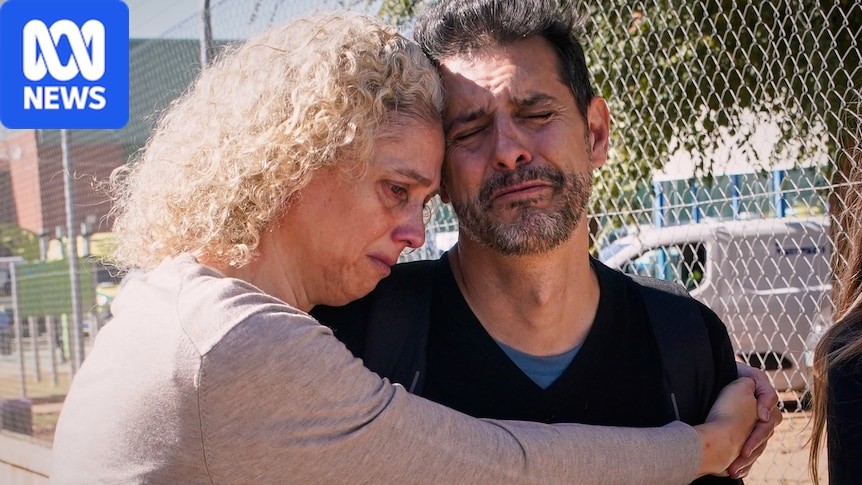
Within hours, Urda was filled with police, firefighters and emergency workers from across the region. The local sports hall became a centre for survivors, while the primary school was reserved for relatives of the victims.
Carmen, a volunteer psychologist from Madrid, said she had been helping grieving families since the morning.
“There were many mothers who found out their children had been killed,” she said.
Some relatives made the two-hour trip from Madrid to search for family members. A woman who gave her name as Ana told reporters she came to Urda after environmental police called to say they had found her dog, Trece, who had been travelling with her husband, Pepe. She fought back tears as she described searching the crash site, the sports hall and the school, adding that his name was not on any list.
Rescue workers continued to scour the wreckage on Wednesday in search of survivors and the bodies of victims.
What Australians need to know
Education Minister Jason Clare said the Department of Foreign Affairs and Trade was not aware of any Australians affected by the crash.
“As you'd expect, we've got consular officials in Spain who stand ready to help any Australians or any Australian families if they are affected,” he told the ABC. “I think the whole country is in shock at the moment, seeing these images on our screens. [They're] just horrific.”
DFAT offered its condolences in a statement to the victims' families and all those affected by the collision.
Spain's history of rail disasters
The collision is the deadliest rail accident in Europe since a 2013 derailment at Santiago de Compostela in north-western Spain killed 80 people. The Guardian reports that Wednesday's disaster has also stirred memories of the Adamuz rail crash in January, in which 46 people died.
The BBC notes that survivors have spoken of shock, panic and anger over the accident, with questions mounting over how a state-operated train could strike a stationary service on a modern high-speed line.
Investigations into the cause of the collision continue, with attention expected to focus on signalling systems, train dispatch procedures and the decisions made in the moments before the RENFE train departed again after its brief stop.
Questions readers are asking
How many people died in the Spain train crash?
At least 68 people were killed and dozens more injured when the two trains collided in Toledo province on Wednesday, local time.
Which trains were involved in the crash?
A train operated by the state-owned company RENFE struck the rear of a stationary train run by the private operator IRYO. Both were carrying passengers between Madrid and Seville.
Were any Australians affected?
The Department of Foreign Affairs and Trade said it was not aware of any Australians affected, and consular officials in Spain stand ready to assist.
What happens next?
Spanish authorities are investigating the cause of the collision, and Prime Minister Pedro Sánchez has called for increased safety measures to restore confidence in the country's high-speed rail system.