
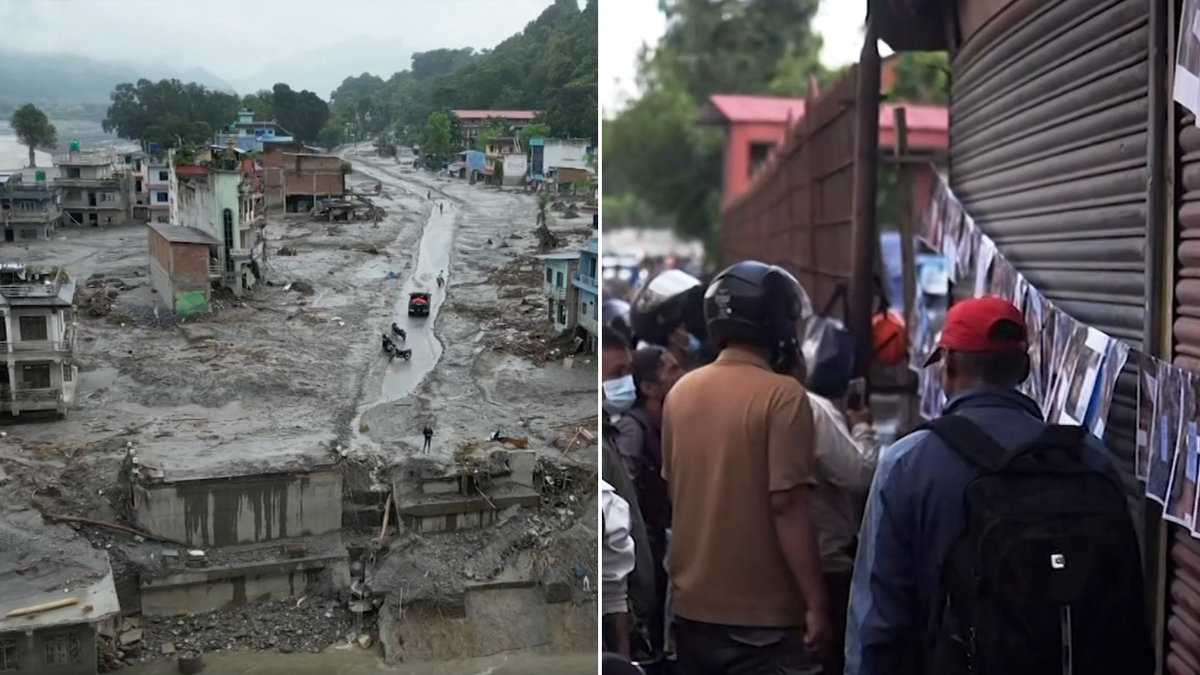
The scale of the flood catastrophe in Nepal is becoming clearer, with the death toll now above 600 and more than 3,000 people missing, including 41 Australians. Families are dropping everything to search for their missing loved ones as entire towns have been wiped out by the devastating floods.
The town of Trishuli, which just days ago was bustling with tourists on pilgrimage for a Hindu festival, is now empty and choked by mud and rubble.
“There were shops, poultry farms and government offices,” one local man said. “But they’re all gone.”
It is the same story in nearby Devigat, lost to the fury of nature. For many, it is beyond comprehension. Two bridges that used to connect one town to the major highway have been destroyed. The sheer force of the water moved concrete and metal like it was nothing. Locals say 300 residents ran for their lives.
Nepal welcomes international assistance
With a nation crying out for help, former Vice President Nanda Kishor Pun has shut down claims Nepal won’t accept international assistance, telling 7NEWS that foreign rescue teams are welcome and that global warming triggered the disaster.
“The world should take notice,” he said.
Australians among the missing
For Australian Bhavin Patel, life hasn’t been the same. Collapsing into the embrace of family, he has flown halfway around the world to find his wife, Reshma. She was on a pilgrimage when the flood came through. He hasn’t heard from her since. Reshma is one of 41 Australians now missing.
So too is Brisbane dad and Royal Australian Air Force member Karan Bhardwaj, who was travelling with mates and is now nowhere to be seen.
Families search for answers in Kathmandu
In Kathmandu, families are gathering at hospitals, holding out for answers, but many have lost hope.
“If we do not get him alive, we want to see his body,” one family member said. “I’m hopeful that I at least get his body,” another said.
One mother broke down in tears after travelling from hospital to hospital in agony not knowing what happened to her son. “Whoever finds out what happened, where he is, just let me know,” she said.
At the morgue in Kathmandu, crowds of people are gathering as ambulances arrive. Photos on the walls show the faces of those who have lost their lives. Sydney man Pjay Srestha says many of the faces are family to Australia’s Nepali community, but the faces missing from the wall deepen the heartbreak.
“I had a friend, he reached out, and then I asked him, where is this individual last seen? And then he sent a map, and it was right in the middle of the flooding, and I just didn’t know what to say,” Srestha said.
Rescue efforts continue amid the devastation
They are praying for a miracle. In one extraordinary scene, a home somehow stands up to the fury of the torrent while others around it vanish, as a family watches from the balcony, stranded but alive.
Nature’s worst has brought out humanity’s best. Days after the disaster, rescue finally came for workers trapped at a hydropower station. Too weak to walk on their own, some were carried, others dragged to freedom.
The bulk of the rescue operation is being coordinated in Nuwakot, about two hours’ drive northwest of Kathmandu, which is essentially the entry point to the disaster zone. All other roads are cut off and only accessible by air. Helicopters have been flying in and out all day from the Nepalese army barracks, where survivors are being taken, but sadly, more often than not, the deceased.
Australian DFAT team heads to Nepal
A specialist DFAT team from Australia has departed for Nepal to help with the rescue and recovery. But when they arrive, it will be a race against the clock to locate survivors, many of whom have potentially been buried under mud for days.
What is being done to help Australians in Nepal?
The Australian government has deployed a specialist DFAT team to Nepal to assist with rescue and recovery efforts. The team will work to locate missing Australians and support local authorities in the disaster zone.
How can families get information about missing loved ones?
Families of missing Australians are urged to contact the Department of Foreign Affairs and Trade’s 24-hour consular emergency centre. DFAT is coordinating with Nepalese authorities to provide updates as information becomes available.