
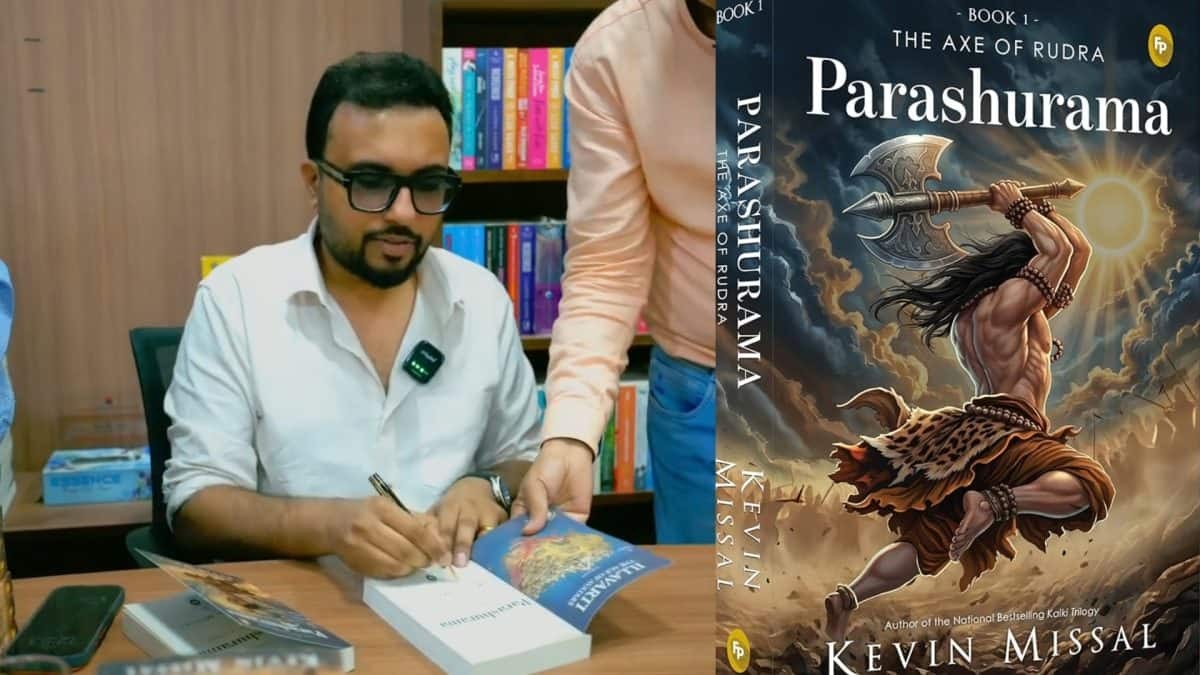
Indian author Kevin Missal has built a career on reimagining the lesser-known corners of Hindu mythology. With his latest novel, Parashurama, he turns to one of the most widely recognised figures in the tradition, yet one whose own story has rarely been told on its own terms.
Missal, who previously wrote about Kalki and Narasimha, had long wanted to explore the sixth avatar of Vishnu. The idea eventually found its way to his publisher, and now to readers. In an exclusive interview, he explains why Parashurama felt like the right subject, how he approaches writing for a global audience, and where he stands on artificial intelligence and shrinking attention spans.
Why Parashurama now?
Unlike some of the figures Missal has written about before, Parashurama is not a niche character. His presence spans the length of India, from the north to the south, east to west. That broad recognition was part of the appeal.
“Parashurama as a figure of God and as an avatar is a very relevant figure across India,” Missal says. “When I was writing books on Kalki, when I was writing books on Narasimha Avatar, only a few people knew about him. Lord Parashurama, everyone knows him.”
But recognition does not mean a full story. In most retellings, Parashurama appears only in relation to Lord Ram, often as a supporting figure in someone else's arc. Missal saw an opportunity to correct that imbalance.
“When you read about or listen about Lord Parashurama, what happens is you only learn that through his connection with Lord Ram,” he says. “His own journey has been very, very obscured and I feel personally that through this book, I want to get it out there.”
How Indian mythology travels across borders
A common question for any author taking mythology to an international readership is how much cultural context needs to be explained. Missal does not believe the answer is to dilute the story's Indian identity.
Instead, he argues, the universal appeal lies in the emotional core. Parashurama's story includes a son losing his father and seeking vengeance, a theme that resonates far beyond any single culture.
“You can look at Chinese mythology, Arabic or Greek or anything. This kind of storytelling can be prevalent in any mythology,” he says.
Grief, revenge, love and loss are not exclusive to any one tradition. That, Missal believes, is how an Indian story travels without losing its roots.
Writing for the ear as much as the eye
Missal also wrote with audiobook listeners in mind. A self-described audiobook enthusiast, he wanted Parashurama to work for someone listening on a treadmill or in a car, not just someone sitting down with a physical copy.
His approach was to make the prose more atmospheric, leaving space for the listener's imagination to fill in the visuals.
“When you show something, it automatically becomes very, very scenic for them to listen. So telling should be less,” he says.
The audiobook edition of Parashurama is available on Audible.
Music sets the tempo for battle scenes
Writing action sequences requires a certain rhythm, and Missal finds that rhythm through classical and film scores. Mozart, Beethoven, Star Wars themes and Hans Zimmer's Gladiator soundtrack all feature in his writing process.
“I don't use lyrical. So that kind of allows me to be very pacey and fast and control the tempo. Because I'm never able to write a very fast scene if I don't use music,” he says.
The connection between music and his books extends beyond the writing desk. He enjoys seeing modern musical accompaniments attached to his audiobooks on Audible, noting that it reflects how he imagined the scenes while writing.
Why he won't write for the scroll
Missal has been writing long before the rise of short-form video content, and he has no intention of reshaping his books to fit shrinking attention spans. He calls the micro-content culture a fad, while acknowledging he could be wrong.
He watches reels himself, and his wife consumes a great deal of Chinese and Japanese micro-content. But he does not believe story length is what determines success.
“I don't care whether the book or the audiobook is short or large. It doesn't really matter. What matters is if it's a good story,” he says.
That conviction led him to resist editorial suggestions to cut Parashurama down for readers who might find its length challenging.
“I said, I shall not cut down. The story is written the way it's supposed to be written,” he says. “It can't be cut down just so that I can pander to the readers. It has to service the story. And the reader is intelligent enough and smart enough to know that the book requires length.”
What AI can and cannot replace
For any author working in 2026, artificial intelligence is an unavoidable topic. Missal does not pretend it does not exist. He uses it himself, though more as a brainstorming partner than a ghostwriter.
“For me, AI has become like a songbook. I throw ideas at it. He throws it back to me,” he says. “It's a give-and-take relationship that I have with it.”
He enjoys testing it with absurd ideas and seeing what comes back. But when it comes to the final prose, he draws a firm line.
“While my thoughts are more structured, my writing stays true to me, which is raw, which is flawed,” he says. “And I think that's where the writers, readers also will kind of understand that if there are mistakes in this book, that means it's not a manufactured, synthetic product.”
His belief is simple: people want real things. The more comfortable audiences become with AI, the more they may seek out work that feels unmistakably human.
Consuming stories versus analysing them
Missal's writing process involves more than just absorbing stories. He actively analyses the films, books and audiobooks he consumes, keeping detailed notes on subtext and narrative choices.
“We as humans, we ingest a lot of content, but we don't analyse them,” he says. “So I think what happens is, I do the second step also. So I ingest and analyse.”
That habit helps him craft twists and build intrigue, even when readers already know the broad outline of a mythological tale. Sometimes it means rewatching a show multiple times, first for enjoyment and then for structure.
As for what comes next in the series, Missal is keeping details close. He promises more action, more drama, more mystery and a significant twist in Part 2. The nature of that twist, naturally, remains a secret.
Parashurama is available in print and audiobook formats.