
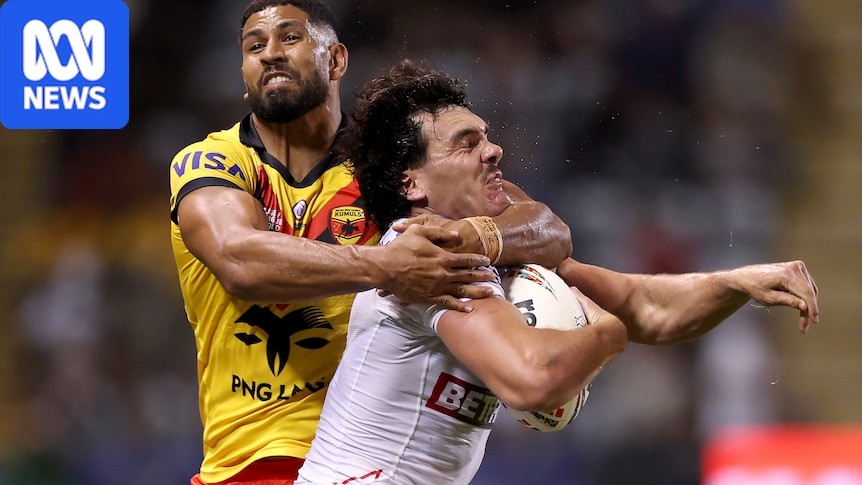
England kept their Rugby League World Cup campaign technically alive with a 34-12 win over Papua New Guinea in Wollongong on Friday night, but the result leaves them needing Tonga to beat Samoa by at least 46 points on Sunday to reach the semi-finals.
The win was England's only likely victory by a northern hemisphere side over southern hemisphere opposition in the entire tournament, a statistic that has sharpened the debate about the state of the game in its birthplace and the rise of Pacific rugby league, according to Australian Broadcasting Corporation reporting.
A win that never felt like enough
England raced to a 22-0 lead inside the first 22 minutes, with their spine combining well for tries from AJ Brimson and Dom Young, and Matty Smith finishing a gift of an offload from Kai Pearce-Paul.
For a brief stretch it appeared England might build the points differential they needed. Then the errors arrived. They did not stop until Matty Ashton dropped the ball in contact in the final minutes, England's 20th mistake of the night, as the Telegraph described a squad getting close to needing a miracle.
Papua New Guinea won the second half 12-10. The margin was just 24-12 with 12 minutes remaining, and only scrambling England defence prevented a genuine contest. The Guardian reported that England's campaign is all but over despite the victory over Papua New Guinea, with the group format effectively deciding their fate before the final round of matches.
The format that decided England's fate early
The tournament structure has drawn criticism since it became clear that England's opening match against Tonga was, in effect, an elimination game. England lost it, suffered their heaviest ever defeat to a Tier 2 nation, and have spent the two weeks since waiting on results rather than controlling their own destiny.
The fixture list has produced an uncomfortable irony: a team can win its final group match by 22 points and still face elimination on points difference. AOL reported that England are heading home barring a rugby league miracle from Tonga on Sunday.
Papua New Guinea's revival points to a Pacific future
For the Kumuls, the signs are more encouraging. Winger Dudley Dutoi and five-eighth Gairo Voro led the second-half revival, and Voro in particular has improved with every exposure to the top level.
The pathways from local Papua New Guinean football are producing capable and exciting players, and the arrival of the PNG Chiefs, with the financial backing attached to them, should strengthen the national side over time. There is money and talent in Papua New Guinea, and the combination is starting to show at international level.
That rise matters for the region. For Australia and the Pacific, the growth of the international game in Papua New Guinea, Tonga, Samoa and Fiji is a genuine sporting development, one that deepens the rugby league footprint across the Indo-Pacific and gives the World Cup a competitive credibility it previously lacked.
The widening gap between hemispheres
England's problems run deeper than one tournament. England or Great Britain have not beaten Australia since 2006, and have not beaten New Zealand since 2018. Fiji scored more points against the Kangaroos last week than England managed across all of last year's Ashes series.
The consensus in the English game is that the Super League standard must rise to give the best players and teams more consistent, higher-quality matches. More English players in NRL systems would improve them individually, but not so many that the domestic competition loses its homegrown stars. That balance is easier to want than to achieve.
What the English game also needs is money to invest in itself, time for that investment to grow, and patience from a fanbase accustomed to disappointment. Everyone agrees on the destination; nobody agrees on the route.
NRL negotiations loom over England's campaign
The undercurrent of England's campaign has been the ongoing negotiation between the NRL and the Rugby Football League over the Australians taking partial or total control of the game in the United Kingdom.
If a deal proceeds, the injection of capital could bring the structural transformation that English rugby league has long struggled to implement on its own. But England would enter any such arrangement at the NRL's mercy, much as they now sit at the mercy of Tonga's goal-kickers and scoreline on Sunday.
For now, England's World Cup hopes amount to a wish rather than a plan. Tonga must beat Samoa by 46 points, and no result in this tournament has suggested that is likely. England are not fighting for a future in this competition so much as hoping for one.
FAQ
What does England need to reach the Rugby League World Cup semi-finals?
England need Tonga to defeat Samoa by at least 46 points in Sunday's final group match to qualify for the semi-finals on points difference.
How did England perform against Papua New Guinea?
England won 34-12 in Wollongong on Friday night, leading 22-0 early before committing 20 errors and losing the second half 12-10.
Why is England's World Cup campaign considered nearly over?
England lost their opening match to Tonga, their heaviest defeat to a Tier 2 nation, which effectively made that game a knockout and left their qualification dependent on other results.