
The United States and Iran have resumed military strikes this week, threatening to reignite a broader regional conflict even as Washington agrees to further negotiations. President Donald Trump confirmed on Saturday that Iran had requested continued talks, but he reiterated that the ceasefire between the two longtime adversaries is effectively dead.
There have been no direct US-Iran talks since last month. However, Iranian media reported that a Qatari delegation was in Tehran after both sides exchanged fire again this week. Three weeks after the two countries signed a memorandum of understanding aimed at turning a months-long ceasefire into a durable peace, the renewed exchanges of fire risk a return to full-scale regional war.
Trump declares ceasefire over
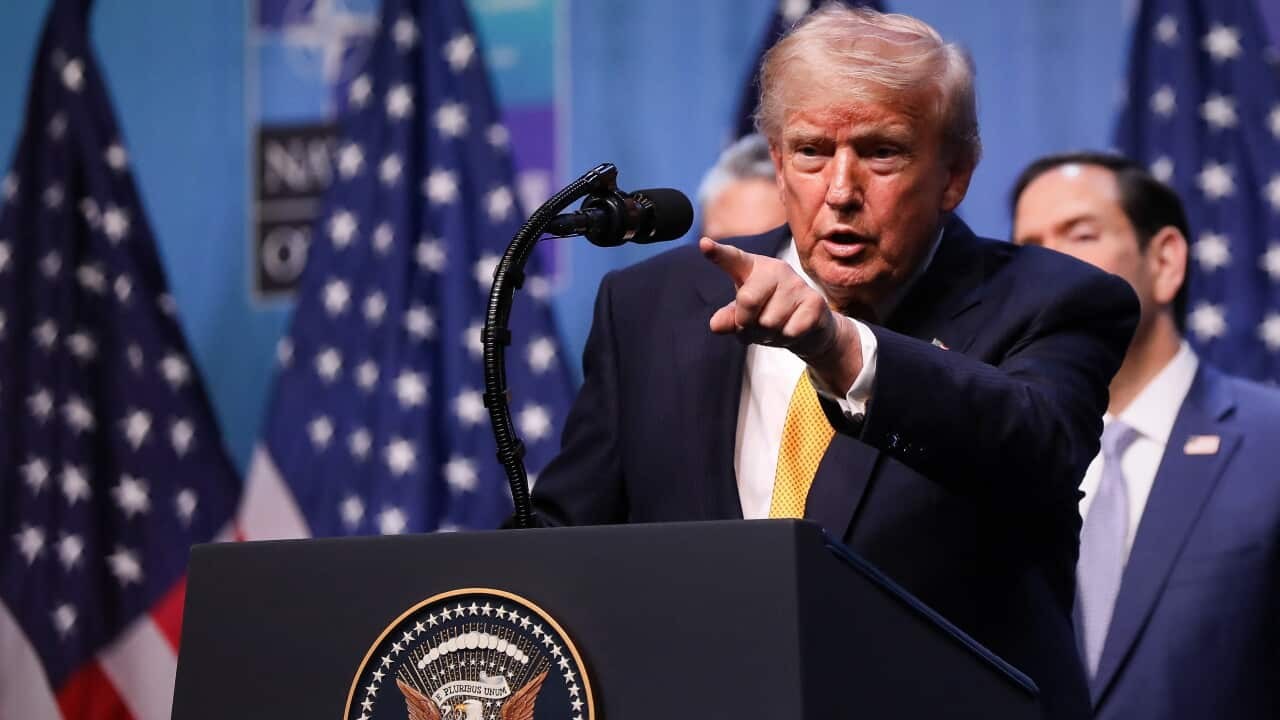
“The Islamic Republic of Iran has asked us to continue ‘talks.’ We have agreed to do so, but the United States has stated to them, in no uncertain terms, that the Cease Fire is OVER!” Trump wrote on Truth Social on Saturday. At a NATO summit earlier this week, Trump had already declared the ceasefire over, saying of Iran: “It’s just a waste of time dealing with them.”
US and Iranian delegations have held one round of direct talks in Switzerland since signing their agreement, as well as indirect negotiations in Qatar. Iranian Foreign Minister Abbas Araqchi is set to travel to Oman on Sunday for talks on bilateral relations and regional developments, particularly the situation in the Strait of Hormuz, according to Iran’s official news agency IRNA.
Strait of Hormuz remains a sticking point
The US is demanding that Iran publicly state it will stop attacks on ships in the Strait of Hormuz and that all shipping lanes will remain open without tolls, senior US officials said on Saturday. Iran has adamantly refused to give up control of the strategic waterway, through which about a fifth of the world’s oil supply typically flows.
US officials said conversations between the two countries had been productive in recent days. “They’re either going to give us that statement or we’re not having a good outcome for them,” one official told reporters in a conference call. Iran has told the US that recent attacks on shipping in the strait were from “an errant part of their system,” the official added. There appears to be a power struggle unfolding in real time between hardliners and pragmatists within Iran, another official said.
Three Qatari and Saudi commercial tankers came under fire this week, prompting the US to hit Iranian sites, and Iran to respond with strikes on US military sites in Gulf states.
Nuclear materials at the core of US demands
The fundamental US demand is that Iran turn over its nuclear materials. Iran is believed to possess more than 400 kilograms of highly enriched uranium, which Trump and other US officials refer to as “nuclear dust.” The nuclear issue is supposed to be dealt with under the 60-day negotiation period laid out in June’s memorandum of understanding.
“I just want to be clear here that if we don’t get the dust, we do not have a deal with Iran,” one official said. The official added that “we have a lot of options” if Iran refuses, including military and economic measures.
US ramps up sanctions on Iran
The US Treasury Department issued new Iran-related sanctions on Saturday targeting a key financier for Iran’s new leader, Mojtaba Khamenei, and 13 other individuals and entities. The sanctions took aim at Ali Ansari, an Iranian banker and businessman based in Dubai who had previously been sanctioned by Britain for his role in financially supporting the activities of Iran’s Revolutionary Guards and other entities, Treasury said.
Treasury’s Office of Foreign Assets Control also targeted three Iran-based exchange houses and foreign “front companies” that it said moved billions of dollars annually on behalf of sanctioned Iranian banks, using layers of shell companies to obscure the government’s illicit activity. The sanctions were announced on a day of relative calm after a week of renewed conflict.
Iran has said it is ready for “all-out defence” if the US violates the memorandum of understanding. Its top negotiator, Mohammad Baqer Qalibaf, vowed on Telegram that the war would never end with Iran’s surrender.
With additional reporting from the Agence France-Presse news agency.