
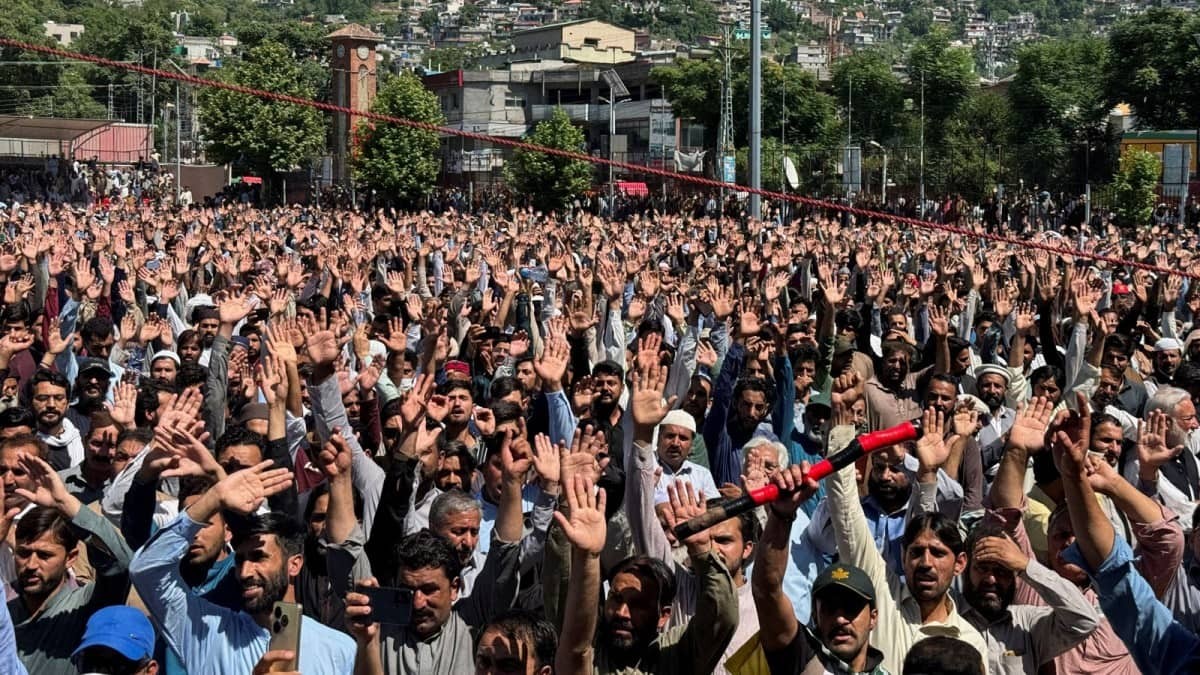
Protests sweeping across Pakistan-occupied Kashmir (PoK) have laid bare the repressive and extractive nature of Islamabad’s governance, according to analysts. The unrest, led by the Joint Awami Action Committee (JAAC), has paralysed towns like Rawalakot, Muzaffarabad, and Kotli, with demonstrators demanding political autonomy, economic justice, and an end to military interference.
The protests are not a spontaneous outburst but part of a pattern of genuine grievances met with state coercion. Islamabad has responded with a three-week blockade of food, fuel, and medicine, a tactic widely condemned as a starvation strategy to crush dissent. This has triggered a humanitarian crisis, with hospitals running out of supplies and black markets thriving amid fuel shortages.
What Is Driving the Protests in PoK?
The anger stems from a mix of political and economic grievances. Politically, the row over 12 reserved legislative seats for Kashmiri refugees in Pakistan is a flashpoint. Locals argue that Islamabad uses these seats to install loyalists with no connection to the region, straining local budgets. The PoK Supreme Court has called for a constitutional amendment to abolish the seats, insisting that representation should rest with residents.
Economically, PoK generates hydroelectric power from dams like Mangla and Neelum-Jhelum, yet locals face high electricity tariffs and frequent blackouts. Inflation has skyrocketed, and the blockade has cut off essential supplies. The JAAC, a coalition of lawyers, traders, and civil society groups, has presented a 38-point charter of demands, but Islamabad has responded with bans, mass arrests, and live fire.
How Does Pakistan Exploit PoK’s Resources?
Pakistan pursues an extractive policy in PoK, siphoning hydroelectricity and water while neglecting development. The region’s geography places it at the headwaters of the Indus River system, making it a hydroelectric powerhouse. Yet locals pay high bills while Pakistani industries benefit. The China-Pakistan Economic Corridor (CPEC) runs through PoK’s Gilgit-Baltistan region, a move critics say undermines local autonomy and drags the territory into Beijing’s orbit.
The Azad Kashmir Interim Constitution Act gives the local assembly little real power, with the Pakistani military and state retaining control. PoK is heavily militarised and used as a launchpad for militant groups targeting India. Analysts warn that resource extraction, unemployment, and coercion have reached a tipping point, with calls for independence growing louder.
Why Is PoK Called ‘Pakistan-Occupied’?
The term reflects the territory’s disputed status. After the 1947 partition, Maharaja Hari Singh of Jammu and Kashmir sought independence but faced invasion by Pakistani tribal militias. He acceded to India in October 1947, leading to the first Indo-Pak war. A UN-brokered ceasefire in 1949 allowed Pakistan to keep the territory it had seized, a move many see as rewarding aggression. The Line of Control (LoC) was drawn, but India maintains that Kashmir’s history and culture are integral to its identity. Pakistan remains an occupying force, and the current unrest signals growing demands for self-determination.
What Are the International Implications?
The crisis has regional and global dimensions. PoK’s instability threatens the CPEC, a cornerstone of China’s Belt and Road Initiative. It also strains India-Pakistan relations, with New Delhi calling for humanitarian access. The international community faces pressure to address the blockade and human rights abuses, but Islamabad’s strategic ties with Beijing complicate intervention. As protests escalate, the slogan ‘Pakistani Forces Out’ gains momentum, echoing broader calls for autonomy across South Asia.
FAQ
What is the Joint Awami Action Committee?
The JAAC is a coalition of lawyers, traders, and civil society groups leading the protests in PoK. It has presented a 38-point charter of demands including political autonomy, fair electricity pricing, and an end to military interference.
How has Pakistan responded to the protests?
Islamabad has imposed a blockade of food, fuel, and medicine, banned civil groups, and used tear gas, shellings, and live ammunition. Mass arrests and information blackouts are routine.
Why does PoK generate electricity but face high bills?
PoK’s dams supply power to Pakistan’s mainland, but locals pay tariffs set for non-producing regions. This discriminatory pricing fuels economic anger.
What is the significance of the 12 reserved seats?
The seats are for Kashmiri refugees in Pakistan, but locals say Islamabad uses them to install loyalists with no local ties. The PoK Supreme Court has called for their abolition.