
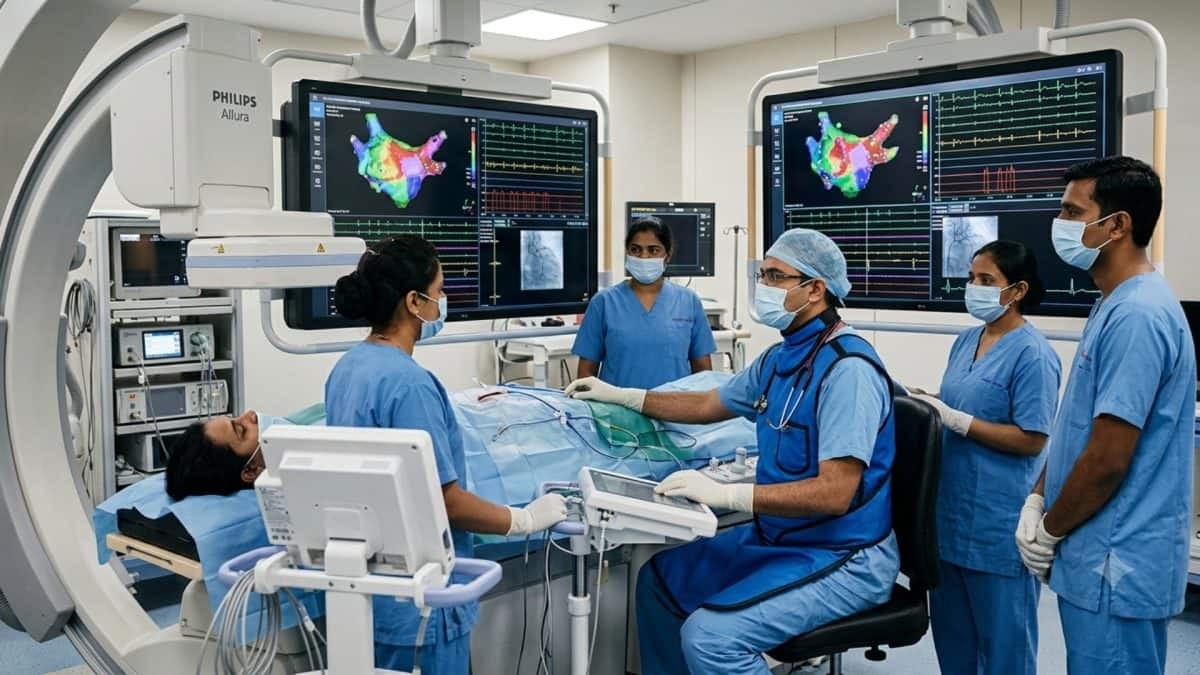
A 62-year-old woman with recurrent atrial fibrillation and hypertrophic obstructive cardiomyopathy has undergone pulse field ablation at BM Birla Heart Hospital in Kolkata, marking an important step in the treatment of complex heart rhythm disorders. The procedure, which uses electrical pulses instead of heat or cold, may offer a new path for patients who do not respond to conventional therapies.
Why is atrial fibrillation difficult to manage in this condition?
Atrial fibrillation is an irregular heart rhythm that develops in the upper chambers of the heart. Instead of beating in a coordinated manner, the atria quiver rapidly and irregularly. When this occurs alongside hypertrophic obstructive cardiomyopathy, a condition where the heart muscle becomes abnormally thick, management becomes significantly more complicated.
In the patient treated at BM Birla Heart Hospital, recurrent AF occurred against the background of significant structural heart disease. The patient had experienced repeated episodes of heart failure requiring hospitalisation despite ongoing treatment and having an implantable cardioverter-defibrillator.
Atrial fibrillation may be harder to treat in hypertrophic obstructive cardiomyopathy, a condition in which the heart muscle is abnormally thick. In this case, the patient continued to have AF despite treatment and was repeatedly admitted with heart failure, said Dr Rakesh Sarkar, Senior Consultant in Cardiology and Cardiac Electrophysiology at BM Birla Heart Hospital.
What is pulse field ablation?
Catheter ablation is an established treatment option for selected people with symptomatic atrial fibrillation. The basic principle is to identify areas responsible for triggering or sustaining the abnormal rhythm and create carefully placed lesions that interrupt those electrical pathways.
Traditional ablation techniques use thermal energy, treating tissue with heat or cold. Pulse field ablation takes a different approach. It delivers short, precisely controlled electrical pulses to targeted cardiac tissue. These pulses alter the electrical properties of the cells in the treatment area, creating lesions intended to prevent abnormal electrical signals from continuing to trigger or maintain atrial fibrillation.
One reason PFA has attracted interest is its potential to reduce unintended injury to nearby structures compared with some thermal approaches, while also allowing rapid delivery of lesions. However, the choice of ablation technique depends on the patient's anatomy, rhythm pattern, symptoms, underlying heart disease and overall clinical condition.
What did doctors do in this case?
The patient underwent catheter ablation using pulse field technology. The procedure included pulmonary vein isolation, a key component of AF ablation, along with ablation of the left atrial posterior wall. The pulmonary veins are important because electrical signals originating around them can trigger AF. During pulmonary vein isolation, doctors create lesions around the veins to electrically isolate those areas from the rest of the atrium.
Dr Sarkar said the decision was made after considering the patient's broader clinical picture. We therefore looked at her overall condition, previous treatment and the pattern of her arrhythmia before deciding on the procedure. We used pulse field ablation to target the areas triggering the abnormal rhythm, intending to give her better and more lasting rhythm control, he said.
Does this mean PFA can cure atrial fibrillation?
Not necessarily. A successful ablation can reduce the frequency and burden of AF, but recurrence remains possible. The outcome can also depend on the type of AF, the condition of the heart, the extent of structural changes and other individual risk factors.
In this case, the hospital reported no clinically documented AF during the first 30 days following the procedure. That is an encouraging early outcome, but it is too soon to use a single patient's short-term follow-up to establish long-term effectiveness. The hospital itself notes that continued follow-up will be necessary to assess sustained rhythm control and clinical outcomes.
Why are newer ablation techniques being studied?
Treating AF is often a balancing act. Doctors want to control the abnormal rhythm while limiting damage to surrounding healthy tissue. Thermal ablation has been used for years and remains an important treatment option. PFA is attracting attention because its mechanism is different and because lesions can be delivered rapidly.
Its potential role is interesting in patients whose AF is difficult to control, although the evidence continues to evolve and individual treatment decisions need to be made by electrophysiology teams. Pulse field ablation may become an increasingly important part of the conversation on whether doctors can achieve durable rhythm control while tailoring treatment to the heart's underlying condition. But for now, longer-term follow-up and larger clinical experience, particularly among high-risk patients with structural heart disease, will determine how far the technology can go.