
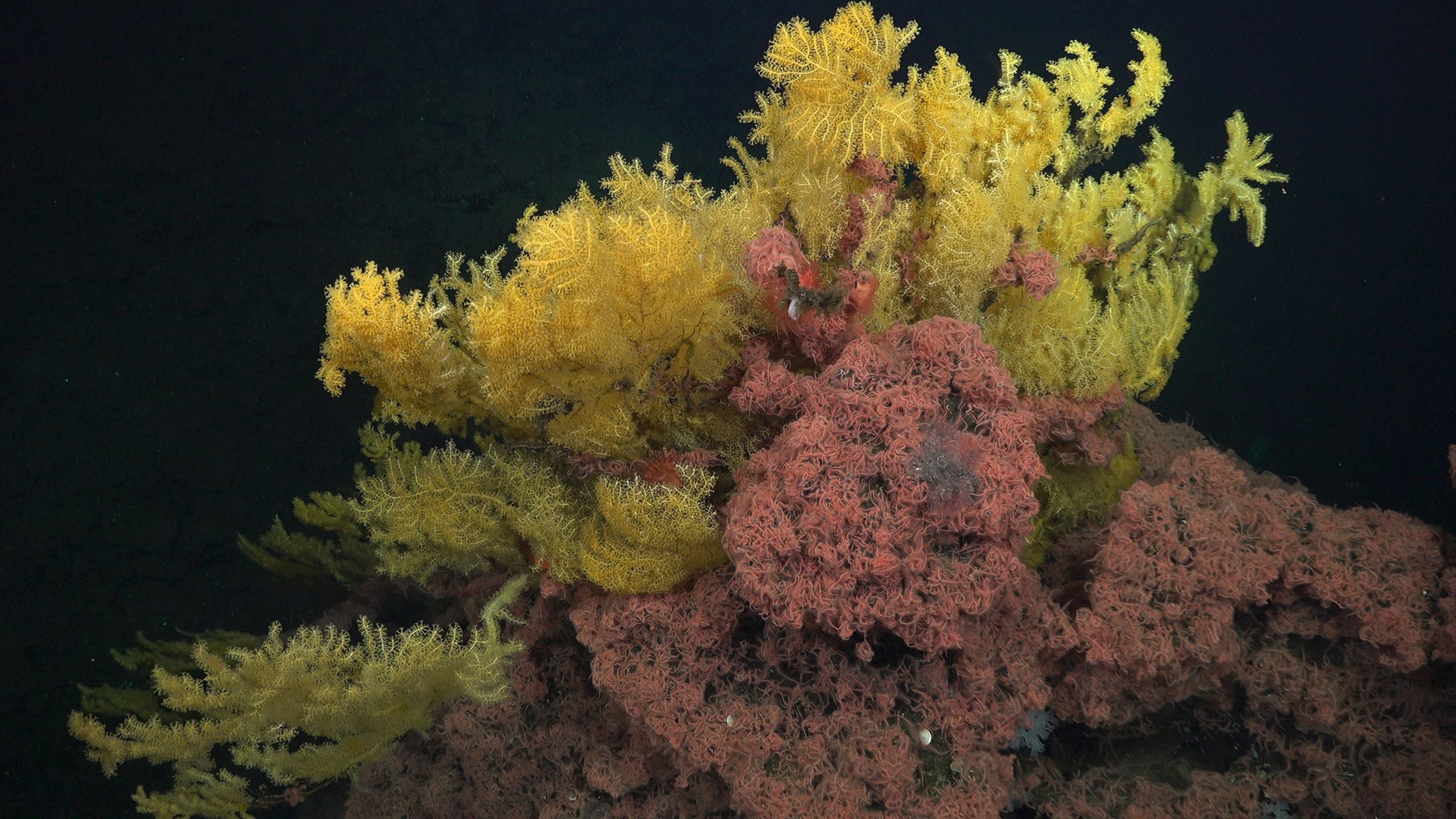
Marine scientists have identified a brilliant yellow deep-sea coral so unlike anything previously catalogued that they had to create an entirely new family on the tree of life to accommodate it. The species, described in a study published in ZooKeys in October 2026, was found on a seamount off the coast of Costa Rica at depths between 360 and 529 metres.
The coral has been named Laurinque elenya, a name drawn from Tolkien's Elvish language Quenya meaning golden tree of the stars. Researchers led by Odalisca Breedy of the University of Costa Rica announced the finding, which grew from specimens collected during submersible dives in 2019 and 2023, according to ScienceAlert.
A coral that fit nowhere
Octocorals are a large group of colonial animals named for the eightfold symmetry of their tiny polyps. The group contains more than 3,000 known species, many of them odd. But Laurinque elenya defied every attempt at classification.
Its colonies grow more than a metre tall and up to 1.2 metres wide, with densely branching structures covered in unusually elongated polyps that can partially retract into the branches. The microscopic skeletal elements that support the coral, called sclerites, show a distinctive mix of shapes. Each of these traits appears in other octocoral groups, but never together in a single species in this combination.
The genetics deepened the puzzle rather than solving it. Breedy's team analysed three genetic markers and compared them against sequences from other octocorals. Two mitochondrial genes each returned confident matches, but with two different families: one placed the coral firmly in Incrustatidae, the other equally strongly in Eunicellidae. The third marker, ribosomal DNA, was inconclusive.
Only after collecting fresh specimens in 2023 and running an analysis of hundreds of genetic regions did the researchers reach an answer. The coral is closely related to Eunicellidae but distinct from it, making Laurinque elenya the first known member of a new family, Laurinqueidae. ScienceDaily, reporting on the study, noted that the combination of anatomy and broad genetic comparison was what finally justified building the species its own branch.
I saw the octocoral garden for the first time in 2019, and I was impressed by the beauty of the landscape, which inspired, later the elvish name of the taxa. I thought the species could belong to a known family and genera, but after the preliminary morphological analysis I realized that it was something very different that I could not match with the known taxa.
Breedy credited colleagues Cathy McFadden, Catalina Murillo and Andrea Quattrini with the molecular work that settled the question of where the species belongs.
Life in water that should be hostile
The golden coral gardens grow in conditions that would kill many marine animals. Oxygen levels in the water are extremely low, and temperatures sit between 8 and 11 degrees Celsius. Yet Laurinque forms elaborate underwater forests there, its yellow branches rising from a seafloor almost entirely carpeted by pink brittle stars, the moving fuzz visible in footage from the Schmidt Ocean Institute's submersible SuBastian.
That habitat value matters beyond the novelty. Deep-sea coral gardens build complex three-dimensional structures that give other animals places to shelter, feed and reproduce, supporting biodiversity in one of the ocean's most difficult environments. Similar deep-ocean discoveries, such as the