
The United States military has confirmed that two of its personnel were killed in Jordan and a third is missing, following an Iranian attack. This comes after a seventh consecutive night of US strikes against Iranian targets. The developments raise serious concerns about a return to all-out war in the Middle East, a prospect that has major implications for global energy markets and Australia's strategic interests in the Indo-Pacific region.
What happened in Jordan?
US Central Command announced the deaths on Friday, bringing the total number of US service members killed since the conflict began to 16. More than 420 have been wounded. Defense Secretary Pete Hegseth posted on X, saying: 'Godspeed, heroes. Their sacrifice only stiffens our resolve.'
How has Iran responded?
Iran's supreme leader, Mojtaba Khamenei, warned that the US will pay for 'seeking to incite war.' In a statement carried by official Iranian media, he said repeated US breaches of an interim ceasefire deal had shown that President Donald Trump's signature was 'utterly worthless and devoid of credibility.' Khamenei added that Iran and the 'Resistance Front' have 'unforgettable lessons in store' for the US.
Iran has also targeted Saudi Arabia, Kuwait, Bahrain, and Jordan. The Islamic Revolutionary Guard Corps (IRGC) claimed it struck a US military support center at Kuwait's Camp Arifjan and destroyed a radar facility at Ali Al Salem Air Base. In Bahrain, the IRGC targeted a site where US combat aircraft were gathered at Sheikh Isa Air Base. In Jordan, Iranian state TV reported that at least two US fighter aircraft and three other aircraft were destroyed during a missile and drone attack on the US base in Al Azraq.
What is the state of the conflict?
The conflict began when the US and Israel launched strikes on Iran at the end of February, aiming to disable its missile program and regional proxies. It has led to major disruption to energy supplies, fears over global inflation, and a battle for control of the Strait of Hormuz, which handles around one-fifth of the world's oil supply.
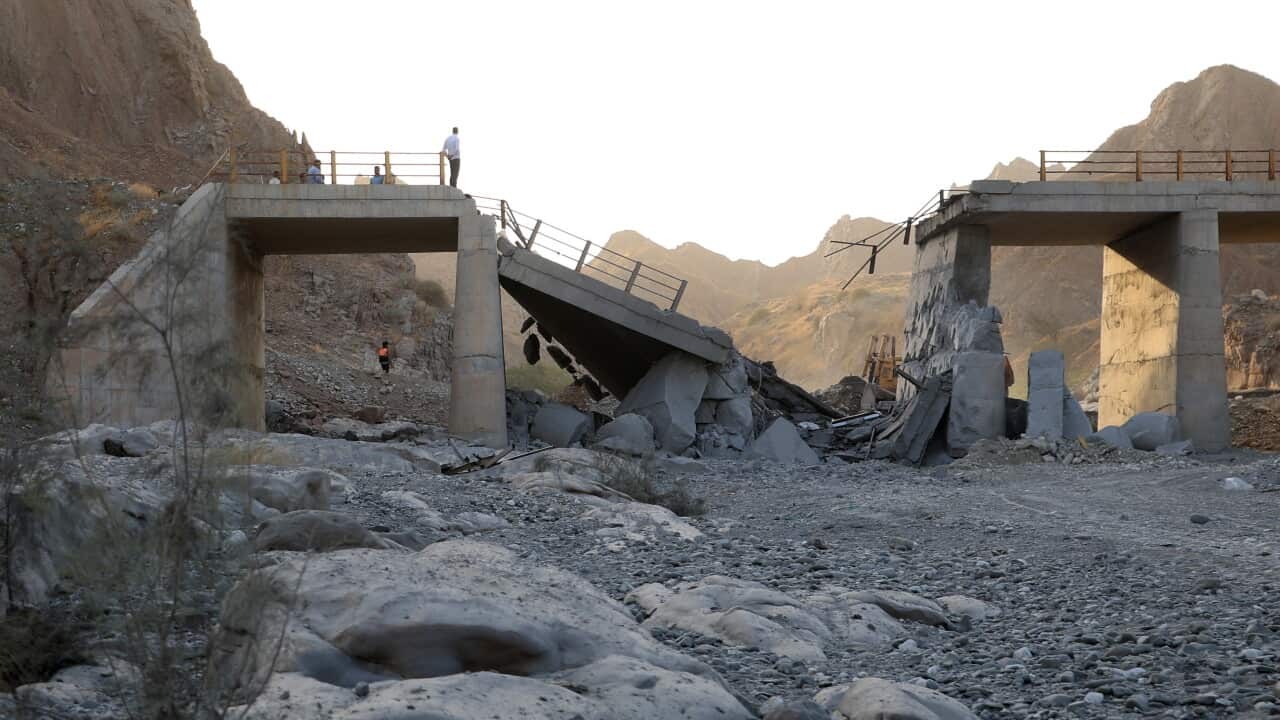
US Central Command said it has completed seven consecutive days of strikes, hitting Iranian surveillance sites, military logistics infrastructure, underground weapons storage, and maritime capabilities. US airstrikes on Saturday killed three people and wounded eight others in Iran's southern Hormozgan province, which borders the Strait of Hormuz. Iran's Health Ministry said 50 people have been killed and more than 500 injured in US strikes over the past three weeks.
What about the Strait of Hormuz?
Both sides have taken aim at shipping traffic. The US says it is enforcing a naval blockade, while Iran says it targets vessels violating its rules on navigating the Strait of Hormuz. A merchant vessel and military forces were involved in an incident off Oman, according to the United Kingdom Maritime Trade Operations, though no further details were given.
What are the broader implications?
The escalation threatens to destabilize the broader Middle East and disrupt global energy supplies. For Australia, which relies on stable energy markets and maintains a close alliance with the United States, the situation is a key strategic concern. The conflict also tests the resilience of multilateral institutions and the rules-based order in the Indo-Pacific region.
Iranian Foreign Ministry spokesperson Esmaeil Baghaei accused the US of seeking control over the Strait of Hormuz. Meanwhile, Saudi Arabia's early warning system issued alerts urging residents of Al-Kharj and Yanbu to seek shelter after an Iranian missile attack, the first on Saudi Arabia in more than three months.