
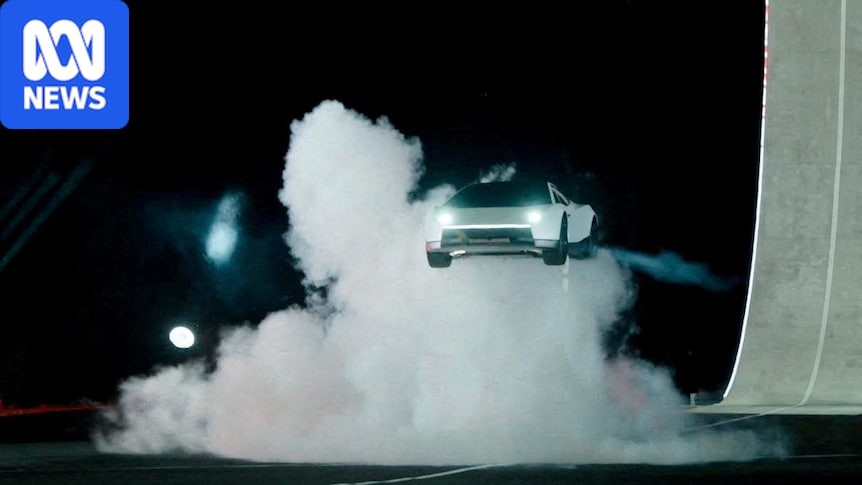
Tesla has unveiled a redesigned Roadster with built-in SpaceX thrusters that Elon Musk says can fly, but Australian experts doubt the car will ever be legal on local roads. The reveal, reported by the Australian Broadcasting Corporation on October 21, 2026, came after nearly a decade of delays on the model.
The vehicle claims acceleration from zero to 97 kilometres per hour in under a second, figures that CarExpert has noted remain unconfirmed for Australian buyers. Production is not expected to ramp up until 2028.
A rocket with number plates
Musk has been blunt about the car's limits. By his own admission, the Roadster is “not necessarily a safety-optimised car”.
“It can basically fly like a rocket. It can do rolls; it can do like crazy gymnastics. Whatever you want really,” Musk said.
“This will be an actual car that's on the roads. I'm not sure it's necessarily legal in all jurisdictions.”
Tesla's reservation page lists three variants, including the “Rocket”, which the company says carries a “full flight system” and cannot be purchased without an invitation. As CarExpert reports, the Rocket variant is explicitly excluded from public-road use, while the street-legal status of the other versions will depend on production specifications and local rules.
What Australian experts say
Michael Milford, director of the Centre for Robotics at the Queensland University of Technology, called the unveiling a “very obvious and admittedly slick publicity stunt” and said the car remains several major transformations away from safe deployment.
“We would likely have helicopter-like flying car transport take off, go to altitude, fly, and land well before we had a ground car that can fly [or] flip,” Professor Milford said. “Even that is a huge uncertainty as to whether that will be feasible in any near time frame, especially in heavily populated areas.”
Milad Haghani, an engineering expert at the University of Melbourne, agreed, describing the Roadster as a technology showcase with no clear path to scale.
“That suggests that at this stage, it's more of a showcase of a technology with no guarantee of scaling up, or not even a pathway envisioned for it,” Dr Haghani said.
“The other thing is you can't expect the regulator to jump on the matter and start regulating right now, because it doesn't exist.”
The safety problem for regulators
Current road infrastructure is not designed for vehicles that leave the ground, and Professor Milford said the Roadster's concept creates the hardest possible safety case: a machine that spends its entire journey close to pedestrians and other traffic.
“Flying cars in close proximity to the ground and everything that entails is in some respects the most complex problem because the whole journey is spent in close proximity to squashy, unpredictable people as well as other vehicles,” he said.
“The advantage of the more conventional flying car type approach is the majority of the journey is separated from these entities.”
He compared the project to Tesla's Cybertruck, which he described as “an impressive stunt, but also of very limited actual utility for now”.
Could a flying car race begin?
Dr Haghani said stunts like Tesla's could trigger a technological race, and the starting flags may already have been waved. California-based Alef Aeronautics revealed its own flying car concept in February 2025, and China has begun experimenting with flying taxis.
He drew a sharp line between corporate-operated air taxis on approved routes and privately owned airborne cars, calling the latter a “completely different matter” sitting in a regulatory void.
“Whether this becomes a viable transport option ... I don't think it marks as big as an advancement as automation or even electrification of cars,” Dr Haghani said.
Professor Milford said he would be surprised if other manufacturers followed Tesla's lead, given the project lacks real-world utility and depends on SpaceX technology most rivals cannot access.
“Tesla can do this technically because of the close SpaceX connection; most don't have access [to] such a leading space tech company,” he said. “It would probably be a significant R&D investment for them to spool something like this up.”
FAQ
When will the Tesla Roadster enter production?
Tesla says production will not ramp up until 2028, and the Rocket variant with its full flight system is available by invitation only.
Can you drive a flying car in Australia?
No. Experts say current road rules and infrastructure do not account for flying vehicles, and no regulatory pathway exists for a privately owned airborne car on Australian roads.
How fast is the new Tesla Roadster?
Tesla claims the car accelerates from zero to 97 kilometres per hour in under one second, using SpaceX-derived thrusters and a fan suction system generating up to 2Gs of downforce.