
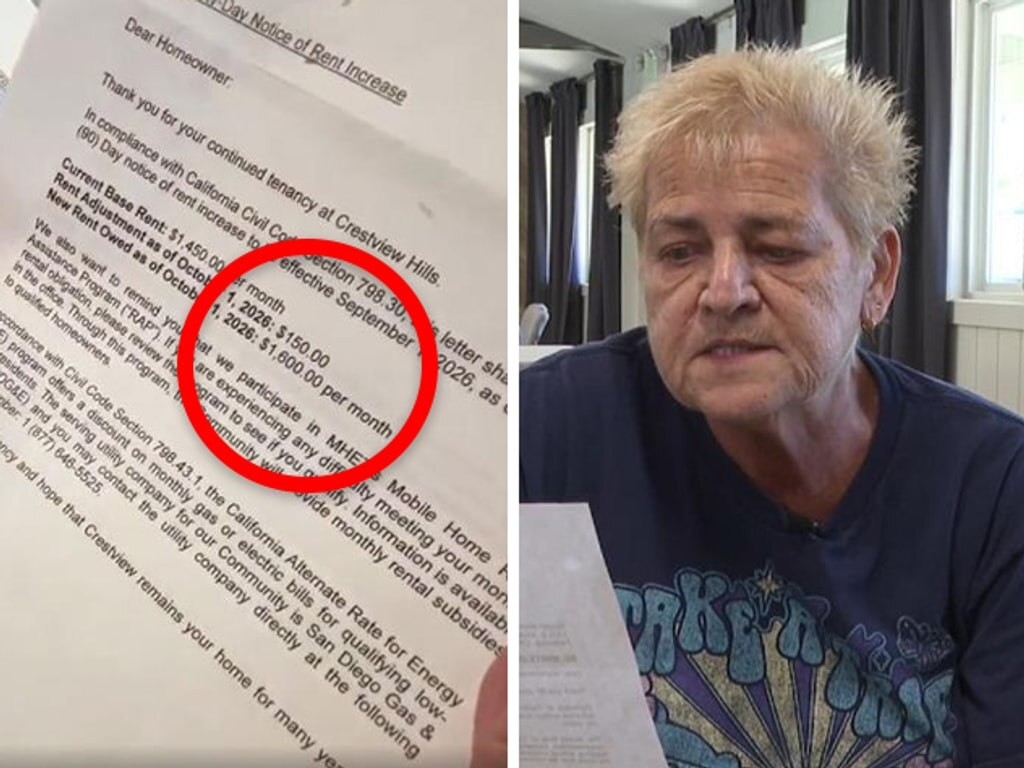
Residents of an over-55s manufactured home park in California have been told to brace for a second rent increase in a single year, after the park's sale triggered a property tax reassessment that the new owner intends to pass on to tenants. The dispute at Crestview Hills Mobile Home Park in Fallbrook, San Diego County, was first reported by Real Estate Australia on 19 October 2026 and has revived debate over how little protection fixed-income retirees have when park rents rise.
The case carries a familiar echo for Australian readers. Residential parks and caravan parks on this side of the Pacific sit under a patchwork of state rules, and advocates here are warning that rent settings for over-55s land lease communities need the same scrutiny.
Rent has nearly doubled since 2017
Retiree Rita Burn moved into Crestview Hills in 2017 paying $825 (AUD $1,182) a month. Her rent now sits at $1,600 (AUD $2,292) a month, and a second increase this year could push it higher still.
“I couldn't believe it. I mean, I had heard rumours that it was gonna happen and then we got the letter,” Burn told the US broadcaster KGTV, which obtained the letter sent to residents.
The letter cited the park's recent sale as the trigger. “The recent sale of Crestview Hills will result in a substantial and near-term property tax reassessment, including supplemental property taxes payable by the new owner. And higher ongoing annual property taxes,” it read, according to KGTV.
Management defends the increase
A spokesman for Cabrillo Management Corporation, the company managing the park, told Realtor.com the rise was calculated on two factors: the replacement of the park's sewer system and the anticipated property tax increase following the sale.
“This increase covers the cost of the sewer system and the estimated property tax increase costs moving forward. Please know that this increase is not profitable to ownership this simply covers increased operating cost,” the company said in an emailed statement.
The email described Crestview Hills as a “five star community” with a clubhouse, pool and jacuzzi, dog park and fitness centre, adding that “continued investment helps maintain the quality of the community.” The company did not disclose the size of either increase this year.
Management also pointed residents to a subsidised rent program and has scheduled a meeting for all homeowners to discuss the increase, the subsidy program and other concerns.
Why mobile home parks escape rent caps in California
The legal position leaves residents with limited room to move. San Diego County has no specific rental laws for mobile-home parks and defers to California's statewide Mobilehome Residency Law. That law requires 90 days written notice of any rent increase, but little else.
“State law does not regulate the amounts of rent that can be charged to a homeowner for rent in a mobile home park,” the Mobilehome Residency Law states.
Most rentals in California fall under AB 1482, which caps annual increases at 10 per cent, comprising a local cost-of-living adjustment of no more than 5 per cent. Mobile-home parks are exempt from those rent-control provisions.
The exemption bites hard because manufactured homes are rarely mobile in practice. Although early models were built on wheeled chassis, modern units are generally not intended to be moved after their initial placement in a park. A tenant facing a rent hike cannot simply relocate the home, which weakens their negotiating position.
Residents organise in response
Burn and her neighbours are now looking for a coordinated response.
“As a group, I think we wanna come up with a plan. Quite a few of us have written to our congressmen and officials to see if they can help in any way. We're hoping to get some legal advice,” she told KGTV.
Why the Crestview Hills dispute matters in Australia
The episode is a warning worth heeding in Australia, where hundreds of thousands of older people live in residential parks, caravan parks and land lease communities. Regulation varies sharply by state, and gaps in rent protection expose residents to increases that fixed incomes cannot absorb.
Victorian industry body Caravan and Residential Parks Victoria (CRPVic) is already pressing the current and next state governments to reconsider fixed rent settings for over-55s land lease communities ahead of the 28 November election,