
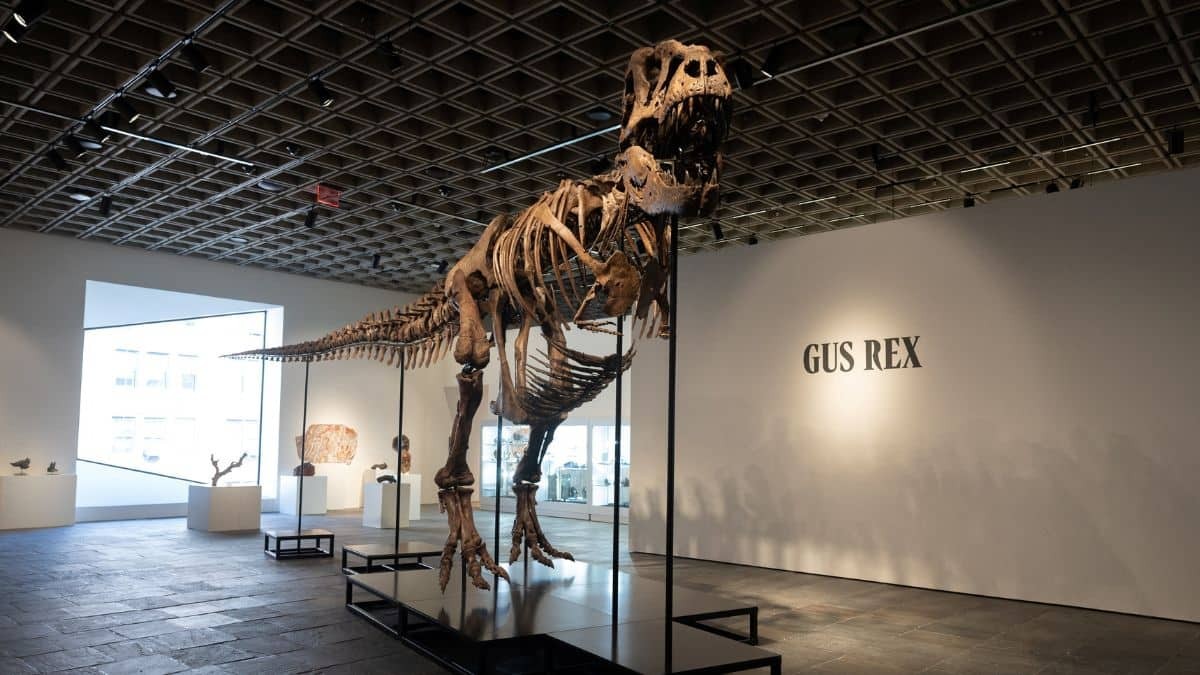
A 67-million-year-old Tyrannosaurus rex skeleton, nicknamed Gus, has sold for $50.1 million at Sotheby's in New York, becoming the most expensive dinosaur fossil ever auctioned. The sale, which took place on Tuesday, has reignited concerns among scientists about the growing trend of selling scientifically significant fossils to private buyers.
The nearly 38-foot-long specimen was purchased by an anonymous bidder. Gus was first discovered in 2021 on a privately owned ranch in Harding County, South Dakota, and is named after the late cattle rancher Gary 'Gus' Licking, on whose land the initial bones were found.
Why scientists are concerned about the sale
The record-breaking price tag has drawn sharp criticism from the paleontological community. Professor Richard Butler, a vertebrate paleontologist at the University of Birmingham, told the Guardian that the trend of marketing dinosaur fossils like rare artworks is deeply troubling. 'Fossils have been bought and sold for hundreds of years, but prices are increasingly out of the reach of museums, much to the detriment of science,' he said.
Professor Stephen Brusatte of the University of Edinburgh echoed this concern. While acknowledging the auction appears legal under U.S. law, which allows landowners to sell fossils found on their property, he noted that such high prices effectively lock museums out of the market. 'If a dinosaur like this fetches tens of millions of dollars at auction, then there's little that scientists or museums or universities can do. Those prices can only be paid by the super-rich,' he said.
Dr Thomas Carr, a vertebrate paleontologist at Carthage College in Wisconsin, argued that private ownership offers no guarantee of long-term preservation or access. 'Fossils need to be available to test previous observations and to make new insights; the fossils are the data, so they must always be available for study,' he said. He expressed hope that Gus might eventually be donated to a public trust, adding: 'A fossil in a public trust is a win for science and society all around rather than being hoarded in some McBillionaire's living room.'
The story behind Gus
The Gus excavation began in 2021 when a research team, having just completed another dig, decided to prospect unfamiliar terrain in South Dakota. Within hours, they uncovered a metatarsal bone. The subsequent five-year project involved excavation, mapping, and restoration, yielding a skeleton that is 63 percent complete by bone count and represents an estimated 75 to 80 percent of the dinosaur's total body mass.
The T. rex was named in honor of Gary Licking, the rancher on whose land the first bone was found. Gary passed away before the project was completed. His widow, Dana, has remained involved, and the team has ensured she sees the prepared pieces as they connect the fossil back to the man it was named after.
What happens to Gus now?
The anonymous buyer has not disclosed any plans for the fossil. Scientists are urging that Gus be loaned or donated to a museum where it can be studied and displayed publicly. As Professor Brusatte noted, if he were a billionaire, he would buy a dinosaur too, but he would donate it to a museum where it could be researched and exhibited.
FAQ
How much did Gus the T. rex sell for?
Gus sold for $50.1 million at Sotheby's in New York on July 14, 2026, making it the most expensive dinosaur fossil ever auctioned.
Why are scientists unhappy about the sale?
Scientists argue that private sales remove important fossils from public access, preventing research and study. They say high prices make it impossible for museums to compete with wealthy private buyers.
Where was Gus discovered?
Gus was discovered in 2021 on a privately owned ranch in Harding County, South Dakota, in the north-central United States.
Is the sale of dinosaur fossils legal in the United States?
Yes, under U.S. law, fossils found on private land can be sold by the landowner. The auction of Gus appears to be legal.