
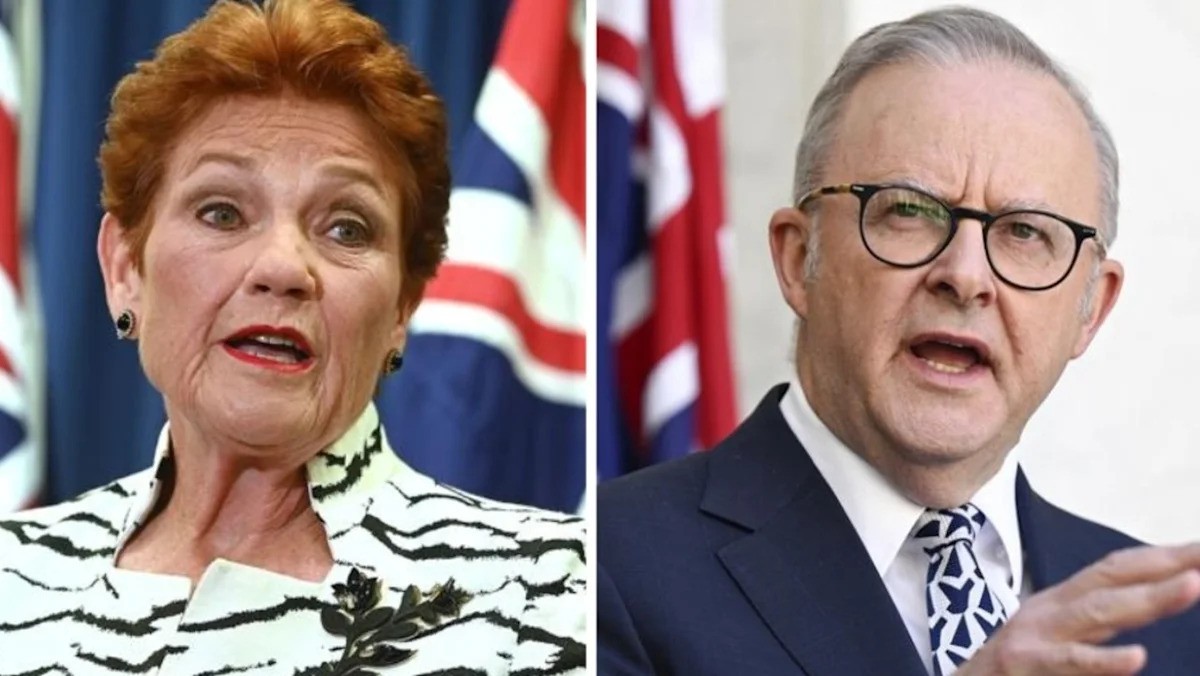
Prime Minister Anthony Albanese has publicly criticised One Nation leader Pauline Hanson for what he described as a pattern of denigrating Australia during her recent overseas trip, urging all parliamentarians to “talk Australia up, not talk Australia down” when representing the nation abroad.
Speaking on Sunday afternoon, Mr Albanese said he was proud to represent Australia on the world stage and expected the same from every elected official. “When I have the opportunity to represent Australia overseas, I talk Australia up. I don’t talk Australia down,” he said. “There’s nowhere you’d rather be than Australia, and I think that it is up to our representatives, no matter where they stand in the parliament, when they’re overseas to talk Australia up, not talk Australia down.”
The Prime Minister added that Australia had become “an extraordinary nation” that the world envied, and that it was the responsibility of all travellers to reflect that pride.
Hanson’s controversial UK mission
Senator Hanson spent much of the winter parliamentary break on a self-described “fact-finding” trip to the United Kingdom, where she met with far-right figures and made headlines for a series of provocative statements. She addressed a conservative political conference in London, where she described Australia as “stupid” for granting rights to transgender people and allowing burqas, and declared she was “sick of hearing about white privilege”.
In the days before her address, she lamented the end of the White Australia policy during a podcast interview and claimed immigrants were “destroying” Australia in the same way they had the UK.
Meeting with far-right activist Tommy Robinson
Senator Hanson’s meeting with Stephen Yaxley-Lennon, known publicly as Tommy Robinson, drew particular scrutiny. Mr Yaxley-Lennon is a far-right activist with a criminal record including convictions for assault and stalking. British authorities have also investigated him for ties to Russian government propagandists and travel to Moscow.
Both Australia and the UK regard Russia as a hostile state and have imposed severe sanctions over its invasion of Ukraine. Mr Yaxley-Lennon first entered politics in the mid-2000s as a member of the British National Party, a fascist party with no elected representatives, and later co-founded the English Defence League, organising anti-Islam protests across the UK. He has since rebranded as an independent media figure associated with alt-right outlets.
During the podcast interview, Mr Yaxley-Lennon praised Senator Hanson as a figure he had “looked up to for years”. He asked how Australia had “Pakistanis, Somalis, all of these African problems with violent Africans”, referencing videos he claimed to have seen. Senator Hanson responded that the change “started” when former prime minister Gough Whitlam “opened up and got rid of the White Australia policy”.
White Australia policy and its legacy
The White Australia policy, embedded in the Immigration Restriction Act of 1901, was a series of race-based laws restricting non-European immigration to preserve a white and largely British society. It was gradually dismantled and fully abolished by Gough Whitlam with bipartisan support in 1973.
Since the interview, Senator Hanson has rejected “false allegations” that she was advocating for the policy. In a social media video, she said: “Do I want people from certain countries that want to wear the burqa? No. What about those marrying their cousins? No. Sharia law? No. Child marriages? No.”
That video was posted just before she told a black-tie conservative conference dinner in London that immigrants were “destroying” Australia like they had the UK. “What I find is happening around the world is that leaders are not doing their best to protect our nations and are being controlled by international interests, and we are not the countries that we once were,” she said. “I see in Australia the problems that you have in Britain. I see immigration is destroying our country as it has destroyed yours.”
Broader political implications
The Prime Minister’s remarks come amid ongoing debate about the role of elected officials in shaping Australia’s international reputation. Mr Albanese’s comments reinforce a bipartisan expectation that representatives should promote national interests abroad, even as they hold differing views at home. The episode also highlights the tension between free speech and the responsibility to uphold Australia’s inclusive, multicultural identity on the global stage.