
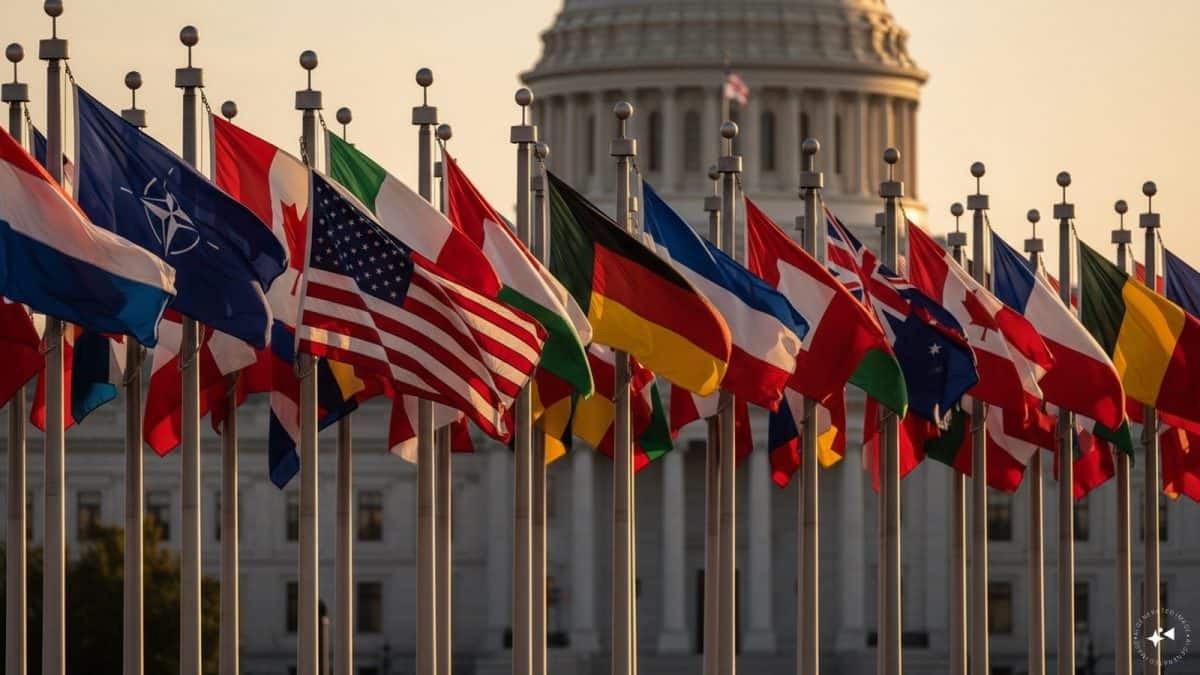
The United States should not ask why middle powers are becoming more independent. It should ask why so many trusted friends now believe they need strategic alternatives.
The recent comments by US Undersecretary for War, Eldridge Colby, on 15 July highlight a growing concern in Washington: that middle powers are drifting away from the US-led order. Colby dismissed the idea of a collective middle-power strategy as a distraction, saying the Pentagon views it as a waste of time, money and political capital. But the real story may be the reverse. The crisis is not that Washington has lost confidence in its partners. It is that many middle powers and long-standing allies have lost confidence in the United States.
Why trust in the United States has eroded
For nearly eight decades after the Second World War, America’s greatest strategic asset was trust. Allies believed the United States would honour its commitments, support an open trading system, and provide stability even when governments changed. That confidence encouraged countries across Europe, Asia and beyond to align with the US-led order. Today, that assumption has weakened considerably.
The erosion of trust did not begin with any one administration. The Iraq War, the 2008 financial crisis, the abrupt withdrawal from Afghanistan, growing protectionism, sanctions used as instruments of economic coercion, and frequent policy reversals between successive administrations have all contributed to uncertainty. Allies increasingly ask whether American commitments are durable or merely contingent on domestic political cycles.
The rise of strategic hedging among middle powers
Rather than choosing between Washington and Beijing, many middle powers have adopted what scholars call “strategic hedging”. India, Indonesia, Saudi Arabia, Brazil, Türkiye and even traditional allies such as Australia and Japan seek deeper cooperation with the United States while simultaneously expanding ties with other partners. This is not evidence of disloyalty. It reflects prudent risk management in an uncertain geopolitical environment.
Even America’s closest friends have begun diversifying their strategic options. European governments have revived discussions on strategic autonomy. Canada has openly questioned excessive dependence on the United States. Asian allies are strengthening regional partnerships alongside their alliance with Washington. These are not anti-American moves; they are insurance policies against unpredictability.
How Washington’s actions fuel the trend
Washington often interprets such behaviour as wavering commitment. But middle powers see matters differently. They are responding to signals emanating from the United States itself. Tariffs imposed on allies, industrial policies that privilege American manufacturing, “friend-shoring” that creates selective economic clubs, and increasingly transactional diplomacy have all reduced confidence in the universality of the rules-based order that the US once championed.
This is particularly significant for India. New Delhi values its expanding strategic partnership with Washington, especially in the Indo-Pacific and critical technologies. However, India has consistently resisted exclusive bloc politics. It remains active in BRICS, the Shanghai Cooperation Organisation, the Quad and the G20 simultaneously. Far from being contradictory, this reflects India’s long-standing commitment to strategic autonomy. The lesson for India is straightforward: partnerships are valuable, but dependence is risky.
The consequences for the international order
The growing importance of middle powers is therefore not the cause of America’s trust problem; it is the consequence of it. As confidence in a single hegemonic leader declines, countries naturally seek broader networks of cooperation. Multipolarity is being driven as much by uncertainty about American reliability as by China’s rise. When China raised concerns in the South China Sea, the Quad emerged as a response.
Some American analysts argue that a coalition of middle powers could fragment the international order and weaken collective responses to global challenges. That concern is understandable. Yet it overlooks why such coalitions are emerging in the first place. Countries rarely seek alternative arrangements when they have complete confidence in existing institutions. The proliferation of minilateral groupings reflects adaptation rather than rebellion.
What the United States must do to rebuild trust
Ironically, this trend could ultimately weaken American influence more than any challenge posed by its strategic competitors. Leadership cannot rest solely on superior military capabilities or technological dominance. It depends equally on credibility, predictability and the confidence of partners. If allies begin to doubt that today’s commitments will survive tomorrow’s elections, they will inevitably diversify their options.
This does not mean the United States is in irreversible decline. It retains unmatched innovation, military reach, alliance networks and financial power. Most middle powers still prefer an engaged America to an absent one. However, preference is no longer synonymous with unquestioning trust. The relationship has become more conditional and transactional.
The central lesson is therefore clear. The United States should not ask why middle powers are becoming more independent. It should ask why so many trusted friends now believe they need strategic alternatives. Rebuilding confidence will require consistency, respect for allies’ interests, and renewed commitment to inclusive multilateralism rather than selective coalitions.
In the final analysis, the defining feature of the emerging multipolar world is not that middle powers have become less trustworthy. It is that the world’s trust in American leadership has become less automatic. That subtle but profound shift may prove to be one of the most consequential geopolitical developments of the twenty-first century.
Jack Thompson is a former ambassador to Indonesia and author of ‘The Durian Flavour’. The views expressed are personal.